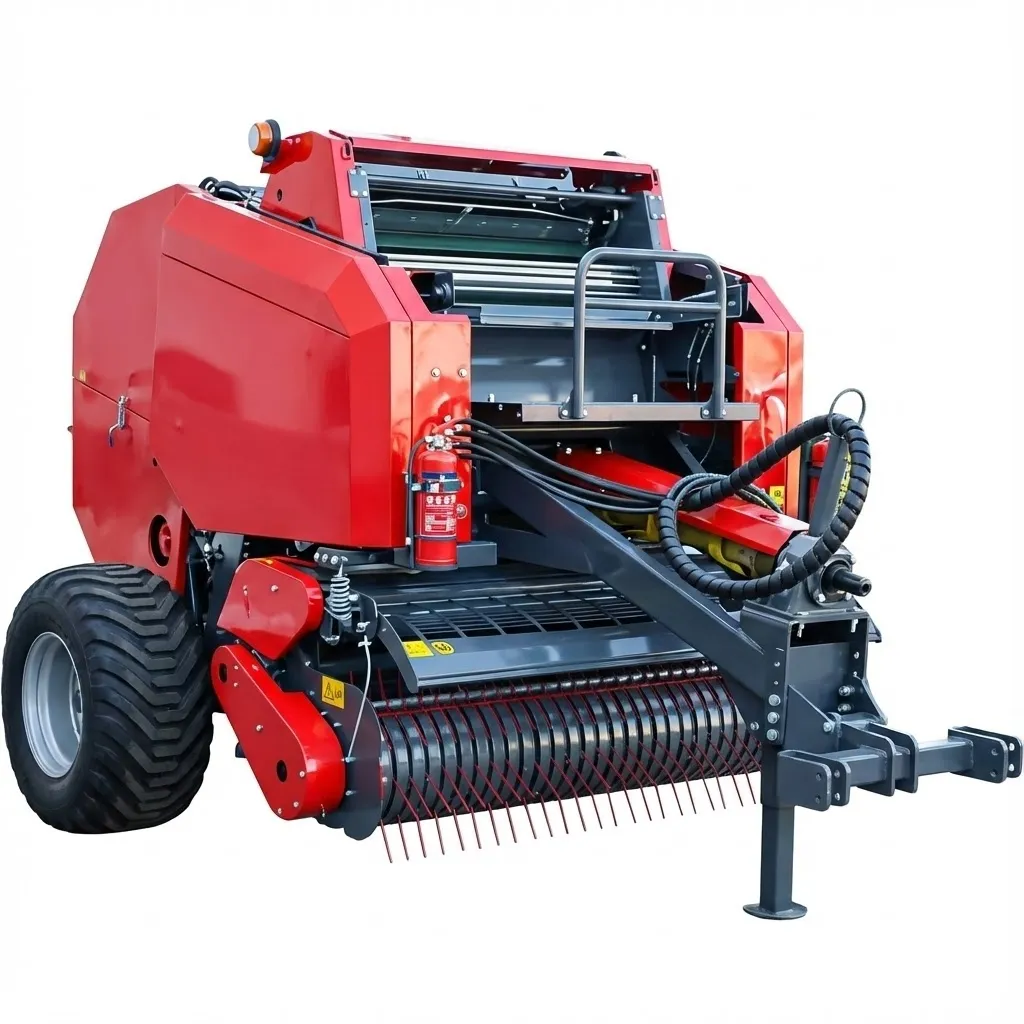
The 9YG-1.0 compact round baler — 65 HP minimum, 2640 kg, suited to farms requiring round bale output without a large tractor investment.
The round baler machine market in India has grown substantially over the last five years, driven by expanding dairy operations requiring high-moisture silage baling, stubble management regulations in wheat and paddy growing states, and increasing awareness of the storage advantages of outdoor round bale storage without a barn. Yet the most common question buyers ask is still the most basic one: should I buy a compact round baler or a large round baler machine, and what is the real-world difference between them?
The answer is not found in the specification sheet alone. It lies in matching bale size, output rate, tractor compatibility, and crop type to the specific operating profile of your farm. This guide covers every comparison point across the three round baler models in the Ever-Power range — the 9YG-1.0, 9YG-1.25, and 9YG-2.24D — so you can make a decision based on field performance, not marketing language.
How Round Baler Machines Work
A round baler machine uses a continuously rotating chamber to form a cylindrical bale from the incoming crop windrow. As the crop is fed in through the pickup mechanism, it is rolled by a series of belts, chains, or rollers that rotate the forming bale at high speed. When the bale reaches the target density, the machine automatically dispenses net wrap or twine to bind the bale, then opens the rear tailgate to eject it.
The fundamental mechanical advantage of a round baler over a square baler is continuous operation — there is no compression ram that must cycle back before the next bale can begin forming. This makes the round baler faster in the field, particularly on high-yield crops where the square baler’s compression cycle becomes a throughput bottleneck.
Fixed chamber vs. variable chamber
Fixed-chamber round balers (including all three models in the 9YG range) produce bales of a set diameter regardless of the crop volume passing through the pickup. Variable-chamber balers adjust their chamber size as the bale forms, allowing the operator to produce bales of different diameters depending on field conditions. For Indian farm operations where handling equipment is standardised and bale weight uniformity matters, fixed-chamber machines are the practical standard.
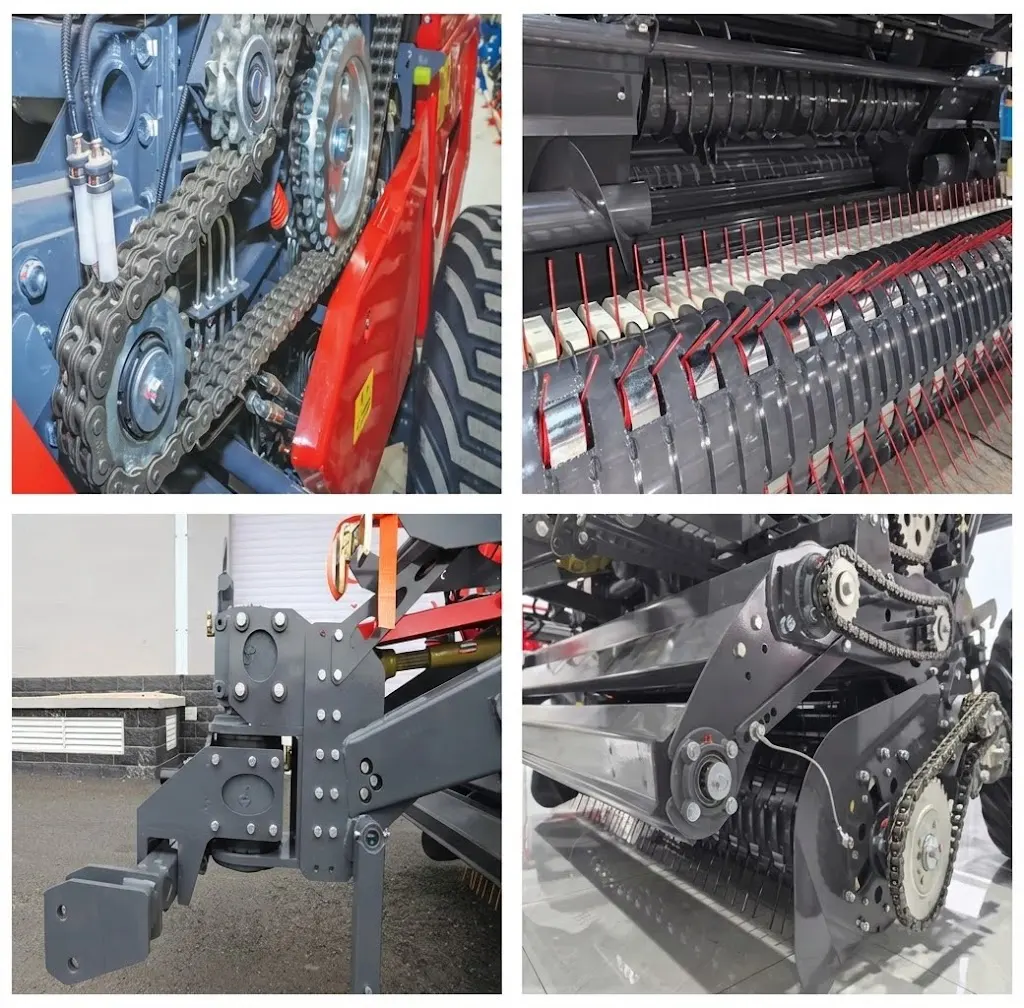
Round baler internal mechanism detail. The rotating chamber walls engage the incoming crop and build the cylindrical bale from the outside inward, maintaining consistent density throughout the bale cross-section.
Compact vs Large: The Core Comparison
The most important distinction between a compact round baler machine and a large round baler machine is not price — it is bale size and the downstream implications of bale size for handling, storage, and transport.
| Specification | 9YG-1.0 Compact | 9YG-1.25 Corn Stalk | 9YG-2.24D Large |
|---|---|---|---|
| Bale diameter | approx. 1100mm | approx. 1250mm | approx. 1300mm |
| Bale width | 1000mm | 1000mm | 1400mm |
| Min. tractor HP | 65 HP | 75 HP | 75 HP |
| Max. tractor HP | 108 HP | 100 HP | 135 HP |
| Pickup width | 1900mm | 1900mm | 2240mm |
| Bale density range | 100 – 200 kg/m3 | 100 – 200 kg/m3 | 100 – 200 kg/m3 |
| Primary crop | Straw, hay, forage | Corn stalk | Straw, hay, silage |
| FOB price range | $8,000 – $11,000 | $9,000 – $12,000 | $14,000 – $19,000 |
The large round baler machine produces a wider bale by 400mm — from 1000mm (9YG-1.0) to 1400mm (9YG-2.24D). This means each bale contains significantly more material per unit, which reduces the total number of bales produced per hectare and the frequency of bale ejection events. For high-yield crops where bale ejection time is a significant fraction of total field time, the larger bale format delivers meaningfully higher throughput.
9YG-1.0 Compact Round Baler — Full Specifications
The 9YG-1.0 compact round baler machine is the entry point in the 9YG range and the most practical choice for small-to-medium farms and dairy operations in India. At 65 HP minimum power requirement it is compatible with a wide range of mid-class tractors in common use across Indian agriculture.
| Specification | 9YG-1.0 Detail |
|---|---|
| Machine weight | 2,640 kg |
| Bale diameter | approx. 1100mm |
| Bale width | 1000mm |
| Min. power | 48 kW (65 HP) |
| Max. power | 80 kW (108 HP) |
| Pickup width | 1900mm spring-tooth |
| Wrapping method | Net wrap or twine |
| PTO speed | 540 rpm |
| Working speed | 5 – 10 km/h |
Best use cases for the 9YG-1.0
- Small dairy operations of 50 to 150 head requiring silage bales for seasonal storage
- Mixed-crop farms producing straw, alfalfa, and pasture grass for livestock feed
- Farms with a single mid-class tractor in the 65 to 100 HP range
- Operations where bale weight (easier to handle) is more important than maximum throughput
- Custom baling services on small and medium-sized paddy and wheat farms
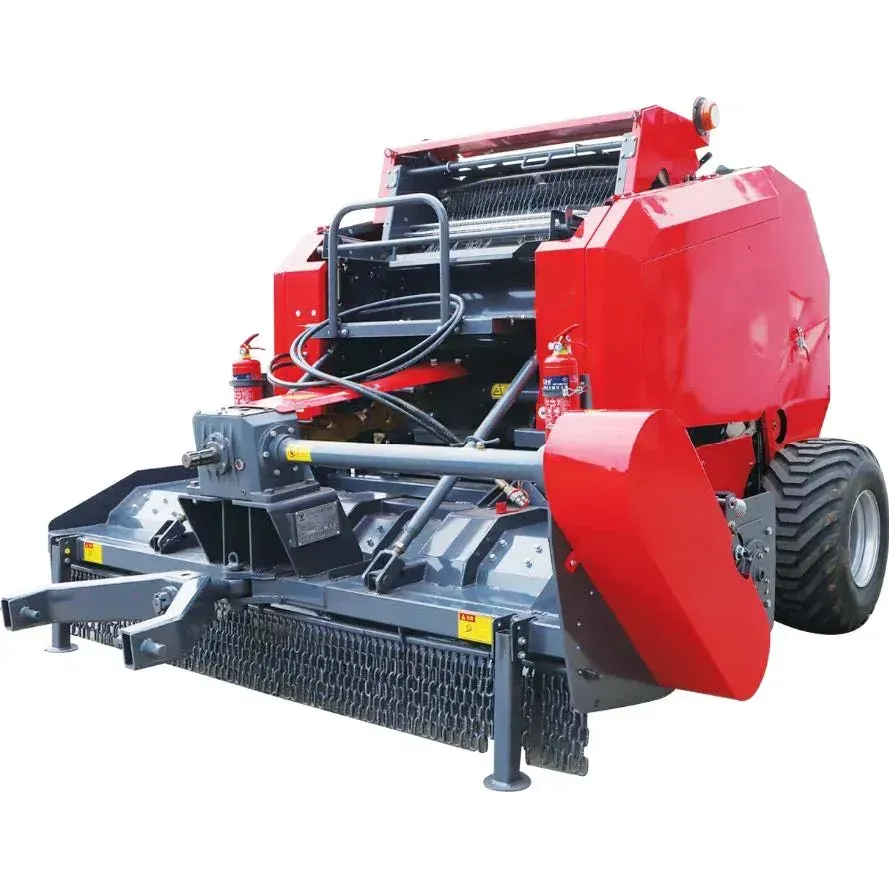
The 9YG-1.0C variant with integrated net wrap system. The compact form factor makes it practical for small farms and mixed operations without a large tractor.
9YG-1.25 Corn Stalk Round Baler — Full Specifications
The 9YG-1.25 is the specialised model in the compact round baler range, designed specifically for corn stalk and cotton stalk baling. It uses the hammer-claw pickup mechanism rather than the standard spring-tooth tines — a critical design choice that makes it the only compact round baler in the range capable of picking up standing or lodged corn stalks reliably.
| Specification | 9YG-1.25 Detail |
|---|---|
| Machine weight | 2,800 kg |
| Bale diameter | approx. 1250mm |
| Bale width | 1000mm |
| Min. power | 55 kW (75 HP) |
| Max. power | 75 kW (100 HP) |
| Pickup type | Hammer-claw — for corn stalk and cotton stalk |
| Suitable crops | Corn stalk, sorghum, cotton stalk, sunflower stalk |
| Crop moisture | 10 – 28% |
The hammer-claw pickup on the 9YG-1.25 is not interchangeable with the spring-tooth mechanism on the 9YG-1.0. If you are baling both paddy straw and corn stalks, you need either two separate machines or the 9YF-2200S square baler with dual-stage shredder. Running a spring-tooth pickup on standing corn stalks will cause pickup mechanism failure within the first season.
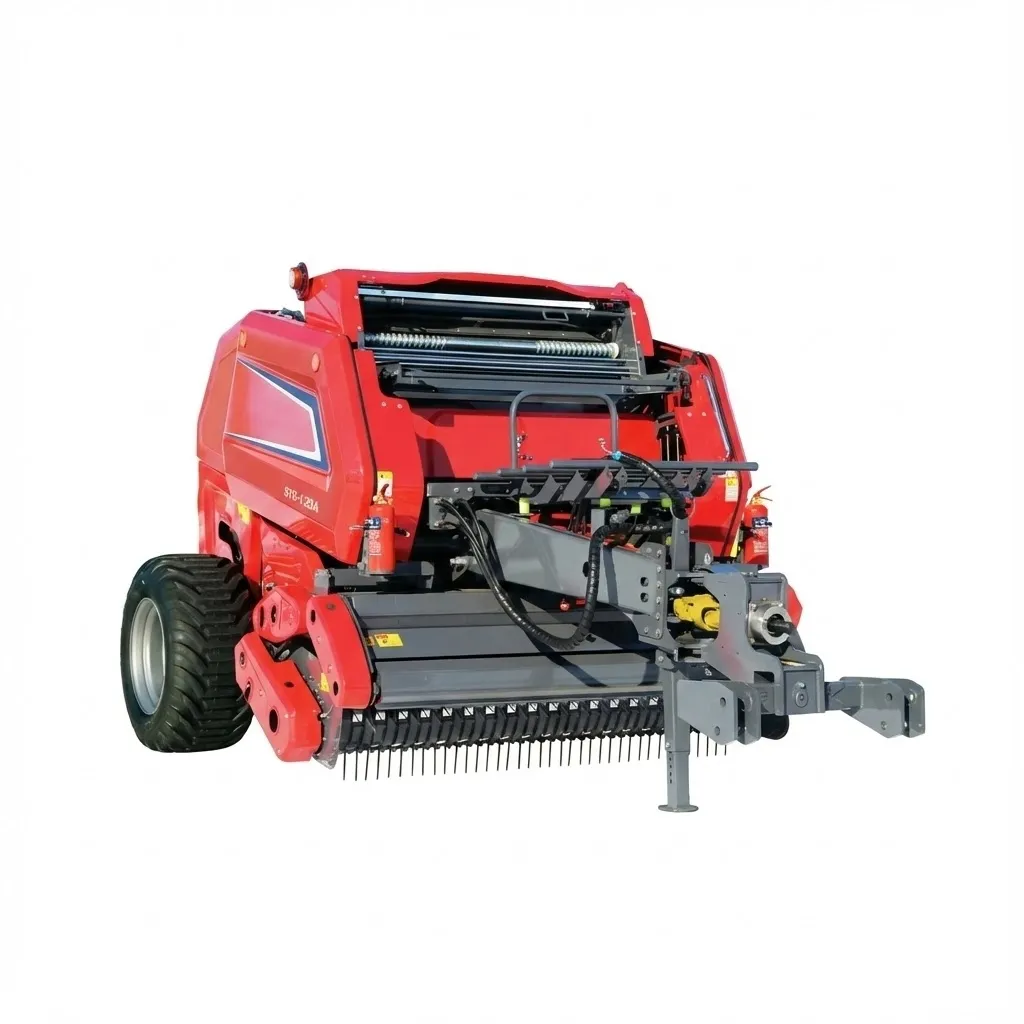
The 9YG-1.25 with A-type frame design. The hammer-claw pickup is visible at the front — this is the key mechanical difference from the standard 9YG-1.0 spring-tooth model.
9YG-2.24D Large Round Baler — Full Specifications
The 9YG-2.24D large round baler machine is the highest-output model in the 9YG range and the standard choice for commercial-scale straw, forage, and silage operations in India and export markets. At 2240mm pickup width it is the widest-pickup round baler in the range and produces the widest bale format.
| Specification | 9YG-2.24D Detail |
|---|---|
| Machine weight | 3,922 kg |
| Bale diameter | approx. 1300mm |
| Bale width | 1400mm |
| Min. power | 55 kW (75 HP) |
| Max. power | 100 kW (135 HP) |
| Pickup width | 2240mm spring-tooth |
| Bale density control | Electronic sensor system |
| Output rate | 40 – 100 bales per hour |
| PTO speed | 540 rpm |
| FOB price range | $14,000 – $19,000 |
The S9000 designation on the current production variant of the 9YG-2.24D refers to the electronic density control system that uses load sensors to monitor bale formation and automatically alert the operator when target density is reached. This system eliminates the inconsistency in bale weight that occurs when operators visually judge bale size — particularly important for commercial silage operations where bale weight directly affects feeding ration calculations.
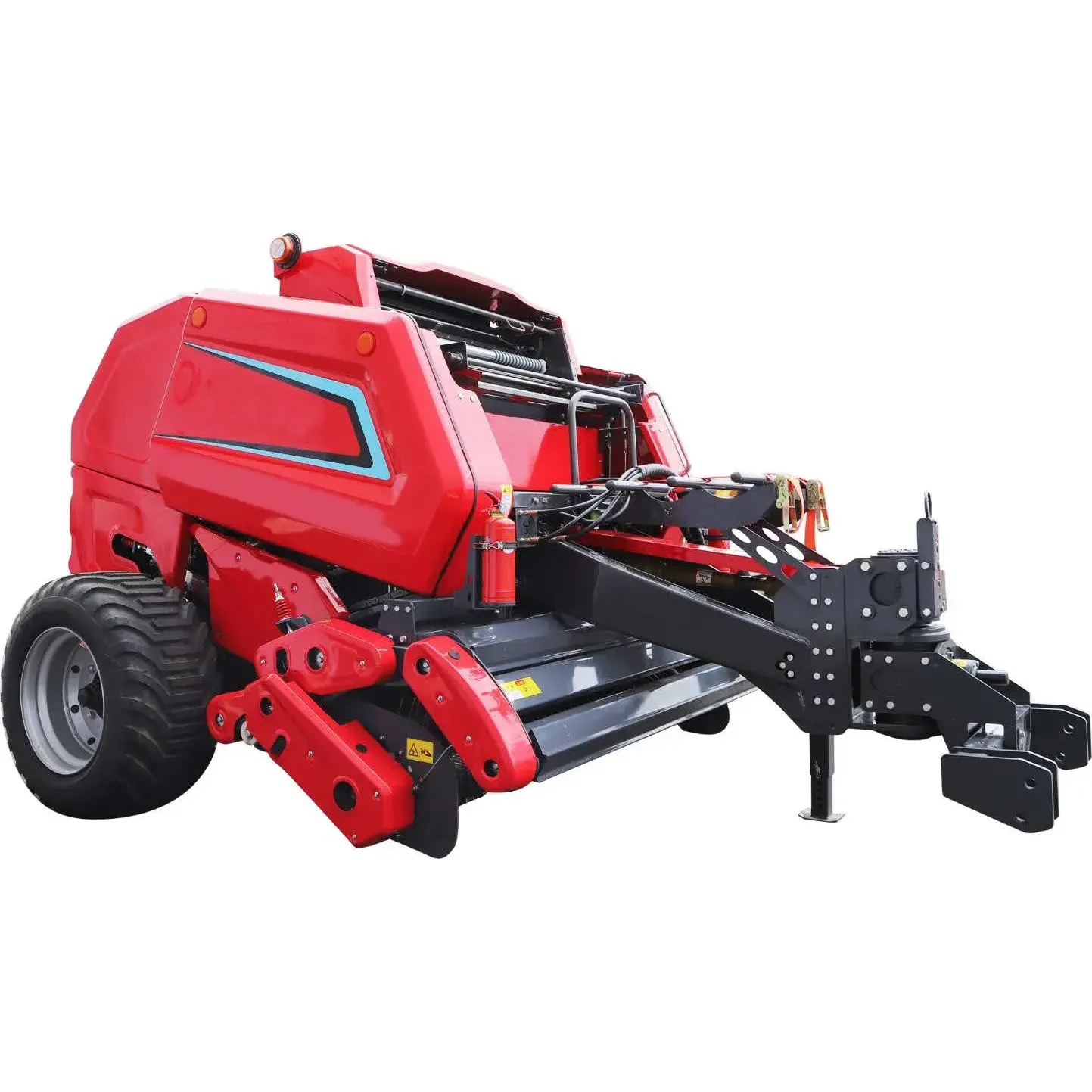
The 9YG-2.24D S9000 in field operation. The wide 2240mm pickup and large bale format deliver the highest throughput per tractor hour in the 9YG range.
Which Round Baler Machine Size Suits Your Farm?
The decision between compact and large round baler machines ultimately comes down to three factors: tractor HP available, seasonal bale volume target, and how you handle and use the bales after production.
Choose the 9YG-1.0 compact if:
- Your tractor is in the 65 to 100 HP range
- Your seasonal bale volume is under 500 bales
- You are baling paddy straw, wheat straw, alfalfa, or pasture grass (not corn stalks)
- You need smaller, lighter bales that can be handled without bale handling equipment
- Your primary application is a small dairy operation or mixed-crop farm
Choose the 9YG-1.25 if:
- Your primary crop is corn stalk, cotton stalk, or sorghum residue
- You need a compact bale format with hammer-claw pickup capability
- Your tractor is in the 75 to 100 HP range
Choose the 9YG-2.24D large round baler if:
- Your tractor is in the 75 to 135 HP range
- Your seasonal bale volume exceeds 500 bales
- You are producing round bale silage and need maximum throughput
- You need the electronic density control system for commercial silage consistency
- You operate a custom baling service or large commercial farm
If you are pairing the 9YG-2.24D with a separate bale wrapper, ensure you have sufficient wrapping capacity to process bales within 12 hours of production. If wrapping capacity is limited, consider the 9YCM-850 integrated baler-wrapper which eliminates this constraint by wrapping each bale immediately on ejection.
- 9YG-1.0 Compact Round Baler — full specifications and pricing
- 9YG-2.24D S9000 Large Round Baler — full specifications and pricing
- 9YCM-850 Baler Wrapper Combination — one-pass silage solution
- Silage Baler Machine Guide — round baler vs square baler for dairy farms
- Straw Baler Machine Price Guide 2026 — complete FOB price reference
Frequently Asked Questions
What is the minimum tractor HP for the 9YG-1.0 compact round baler machine?
The 9YG-1.0 requires a minimum of 48 kW (65 HP) at the PTO. The ideal operating range is 65 to 90 HP. Maximum compatible power is 80 kW (108 HP). Running below the minimum HP threshold will result in inconsistent bale density and increased risk of blockage in the pickup and pre-compression chamber.
Can the 9YG-1.0 round baler handle paddy straw?
Yes. The 9YG-1.0 with the standard spring-tooth 1900mm pickup handles paddy straw, wheat straw, rice straw, alfalfa, and mixed pasture grass without modification. Ensure the paddy straw has been raked into a clean windrow and that moisture is below 18 percent before baling. On paddy straw, pickup tine wear is accelerated by the high silica content — inspect tines annually and replace as needed.
What is the price difference between the compact and large round baler in the 9YG range?
The 9YG-1.0 compact round baler is priced at $8,000 to $11,000 FOB and the 9YG-2.24D large round baler at $14,000 to $19,000 FOB. The $6,000 to $8,000 premium for the large model reflects the wider pickup (2240mm vs 1900mm), the larger bale format, the electronic density control system, and the higher-specification drive components required for the heavier machine weight.
Does the 9YG-2.24D large round baler work with the 9YCM-850 wrapper?
The 9YG-2.24D and the 9YCM-850 are separate machines — the 9YCM-850 is an integrated baler-wrapper combination that includes its own baling chamber. The 9YG-2.24D produces bales that can be processed by a standalone bale wrapper but not by the 9YCM-850 directly. If you need integrated wrapping with the output rate of the large round baler, discuss a two-machine plus wrapper setup with our sales team.
Is the 9YG-1.25 corn stalk round baler suitable for paddy straw as well?
The 9YG-1.25 uses a hammer-claw pickup specifically designed for standing stalks. While it can technically process paddy straw that has already been raked flat, the hammer-claw mechanism is not optimised for low-profile flat material and will produce less consistent bale formation than the spring-tooth mechanism on the 9YG-1.0. If you bale both corn stalks and paddy straw, we recommend two separate machines: the 9YG-1.25 for corn stalk and the 9YG-1.0 for paddy.
Tell us your tractor HP, primary crop, and approximate seasonal bale volume. We send a matched model recommendation and factory-direct price — no sales pressure, no intermediary margin.