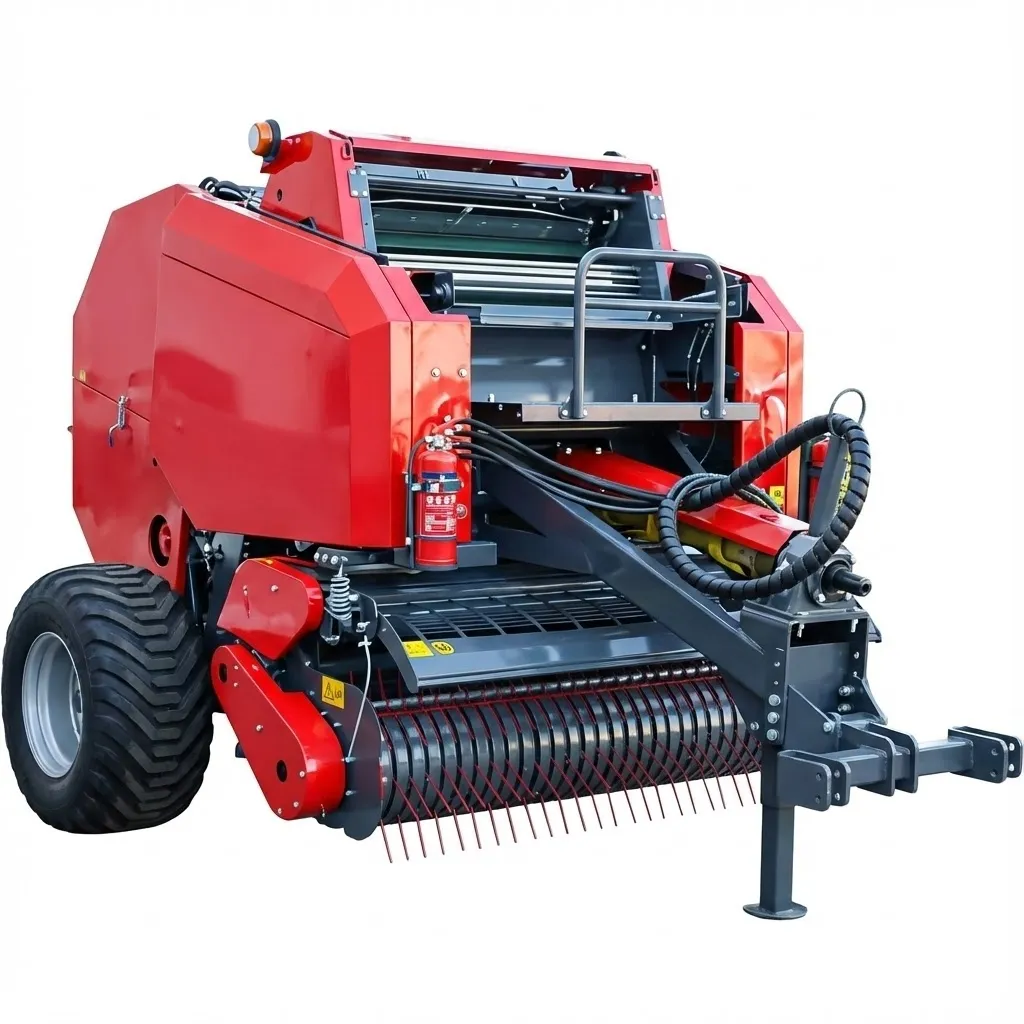
The 9YG-1.0 compact round baler — the closest equivalent to a mini round baler in the commercial market, at 65 HP minimum and 1100mm bale diameter.
The term mini round baler does not refer to a single machine category with standardised dimensions — it is a buyer-facing marketing term that describes any round baler perceived as smaller or more accessible than large commercial round balers in the 1,200 to 1,500 lb bale range. In the US market it typically refers to machines producing round bales in the 48 to 60 inch diameter range: large enough for serious farm use, small enough for a single person or small crew to handle without dedicated bale handling equipment.
This guide identifies which machines in the commercial market actually meet the mini round baler specification, walks through the practical field performance of the 9YG-1.0 compact round baler, and gives you the information to decide whether a compact round baler or a small square baler better suits your specific farm operation.
What Mini Round Baler Means in the US Market
In commercial agricultural equipment terms, a mini round baler is a fixed-chamber round baler producing bales in the 48 to 55 inch (1200 to 1400mm) diameter range, typically weighing 400 to 900 lbs depending on crop and density. This distinguishes it from large commercial round balers producing 5 x 6 or 4 x 5 format bales in the 1,000 to 1,500 lb range that require a tractor with a bale spear or round bale handler for movement.
The 9YG-1.0 compact round baler produces bales of approximately 43 inches (1100mm) diameter by 39 inches (1000mm) width — at the smaller end of what the US market describes as a mini round baler. At the density settings suitable for hay and straw, these bales weigh 400 to 700 lbs, which can be moved with a standard loader tractor, a round bale spear, or a hay unroller without specialized bale handling equipment.
Why bale size matters for your operation
Smaller bales mean more bales per field, more bale handling events, and more net wrap or twine consumed per ton of forage. Larger bales reduce handling frequency but require more equipment and labor capacity to move. For small farm operations with a single tractor and minimal hired help, the smaller bale format from a compact round baler is often the practical choice — the machine is more maneuverable, the bales are more manageable, and the total investment is lower than a large commercial round baler setup.
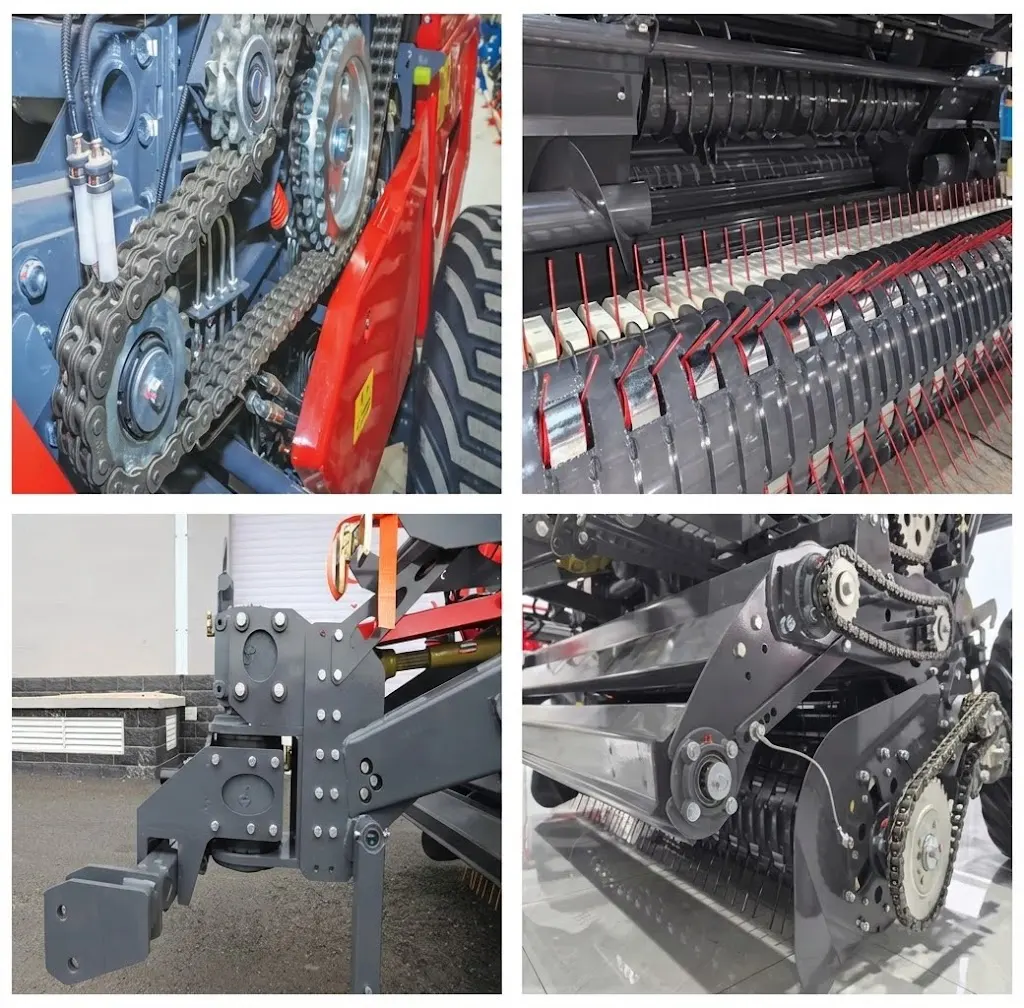
Round bale formation detail. The density and uniformity of the bale is determined by the chamber design, the crop moisture, and the operating speed — not the machine’s size category.
The 9YG-1.0 Compact Round Baler: Full Specifications
The 9YG-1.0 compact round baler is the entry point in the 9YG round baler range and the model that most closely matches the US mini round baler market description. It is a fixed-chamber machine with a 1900mm spring-tooth pickup, producing bales of approximately 1100mm diameter by 1000mm width.
| Specification | 9YG-1.0 Detail |
|---|---|
| Machine weight | 2,640 kg |
| Bale diameter | approx. 43 in (1100mm) |
| Bale width | 39 in (1000mm) |
| Min. tractor HP | 65 HP (48 kW) |
| Max. tractor HP | 108 HP (80 kW) |
| Pickup width | 75 in (1900mm) spring-tooth |
| Bale binding | Net wrap or twine |
| PTO speed | 540 rpm |
| Working speed | 3 – 6 mph (5 – 10 km/h) |
| FOB price | $8,000 – $11,000 |
Key strengths of the 9YG-1.0 for small US farm operations
- 65 HP minimum — compatible with most mid-class farm tractors in common use across US small farms
- Fixed chamber produces consistent bale dimensions for predictable net wrap consumption and storage planning
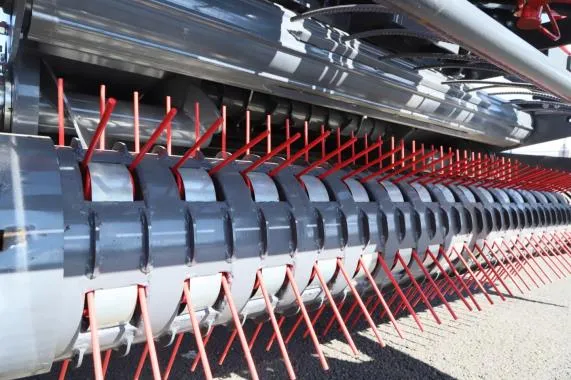
- 1900mm pickup covers a standard 6-foot windrow width without over-reaching
- CE and ISO certified — meets international quality standards and is eligible for agricultural financing
- At 2,640 kg machine weight it is manageable on typical US farm roads without a heavy transport trailer
The 9YG-1.0 in field operation. The 1900mm pickup sweeps a clean windrow at 3 to 6 mph forward speed — the key to consistent bale density on hay and straw.
Mini Round Baler vs Small Square Baler: The Real Comparison
US buyers frequently ask whether a small square baler or a mini round baler is the better choice for their operation. The answer depends on three factors: storage structure, bale handling capability, and crop type.
- No barn required — round bales shed rain and can be stored outdoors
- Faster field operation — no ejection pause between bales
- Better for silage wrapping — film applies evenly to round format
- Handles high-moisture forage better than square balers
- Lower bale-handling labor if you use a loader tractor with spear
- Stackable bales — more efficient use of barn space
- Lower purchase price at equivalent output capability
- Hand-stackable bales without tractor or bale handler
- Better for retail hay sales where uniform small bales are preferred
- Lower net wrap or twine cost per ton of forage baled
The key differentiator for most small US farm operations is storage. If you have a hay barn with sufficient capacity, small square bales stack more efficiently and cost less per bale to produce. If you do not have barn storage, the round baler’s outdoor storage capability is a meaningful operational advantage that changes the economics — particularly in humid southeastern states where uncovered square bales deteriorate rapidly.
Using a Compact Round Baler for Hay Production
For hay production — alfalfa, grass, orchard grass, bermuda, or mixed forage — the 9YG-1.0 performs well across all major US hay crop types when set up correctly. The critical success factors are crop moisture at baling time and windrow density.
Moisture targets for round bale hay
- Net-wrapped round bales intended for barn storage: 16 to 20 percent moisture
- Net-wrapped round bales for outdoor storage: 14 to 18 percent moisture
- Twine-tied round bales: 14 to 16 percent moisture maximum (no film protection)
- Alfalfa specifically: bale at 18 to 22 percent to minimize leaf shatter loss
Baling above the target moisture for outdoor storage leads to heating and mould inside the bale — even round bales stored outside will develop spoilage rings if baled too wet. A good hay probe used in the windrow before baling is a $50 investment that prevents far more costly bale losses in storage.
Bale alfalfa in the early morning when dew slightly raises the surface moisture on the leaves — this is counterintuitive but it actually reduces leaf shatter significantly compared to baling in the hot afternoon when the same leaves become brittle. The slight increase in surface moisture does not push the overall bale moisture above the safe range and the reduction in leaf loss preserves the nutritional value that makes alfalfa worth growing.
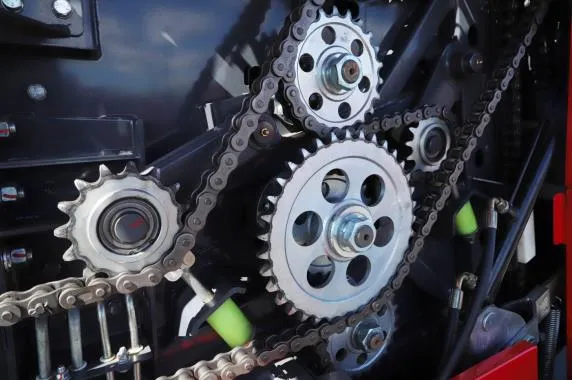
The 9YG-1.0 completing a bale cycle on hay. The net wrap system engages automatically when the density sensor indicates target density is reached.
Compact Round Baler for Silage and Wrapped Forage
The 9YG-1.0 is fully capable of producing wrapped round bale silage when paired with a standalone bale wrapper. For small to medium livestock operations in the US that want to produce their own silage without investing in a bunker silo or silage pile, wrapped round bale silage is a practical and cost-effective alternative.
The two-machine silage system
The standard setup for wrapped round bale silage with the 9YG-1.0 is the round baler plus a standalone satellite ring or table wrapper. The baler produces the bale and ejects it. A second operator (or the same operator with a bale spear on the tractor) moves the bale to the wrapper. Wrapping must begin within 2 to 4 hours of baling for best silage quality — the faster the oxygen is excluded, the higher the fermentation quality.
For operations where the two-machine setup is too labor-intensive or where a second tractor is not available, the 9YCM-850 integrated baler-wrapper combination is the one-pass solution — wrapping each bale immediately on ejection with no gap between baling and sealing.
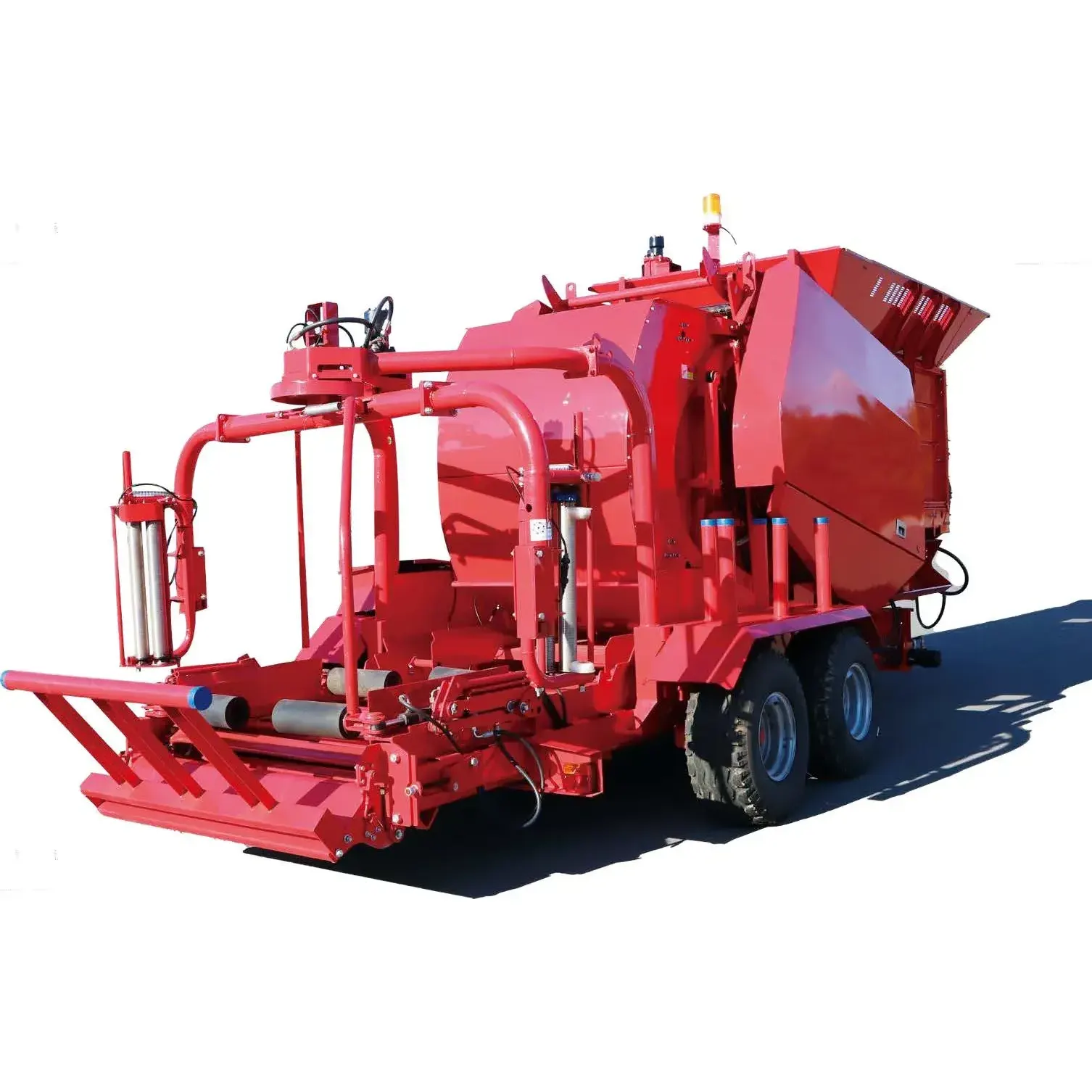
The 9YCM-850 integrated baler-wrapper. For US operations where labor availability is the constraint, this one-pass system eliminates the second tractor and second operator requirement.
Cost of Ownership: What to Budget Beyond the Purchase Price
The total cost of running a mini round baler across a 10-season life includes the purchase price plus annual consumables, wear parts, and maintenance. Here is a realistic breakdown for a 9YG-1.0 running 300 bales per season on hay and straw in a typical US small farm context.
| Cost item | Annual estimate (300 bales/season) | Notes |
|---|---|---|
| Net wrap or twine | $600 – $900 | Net wrap uses more per bale than twine |
| Pickup tine replacement | $100 – $200 | Every 2-3 seasons on normal hay crops |
| Lubrication and fluids | $80 – $150 | Follow manufacturer lubrication schedule |
| Drive belt and chain service | $150 – $300 | Every 2-3 seasons depending on hours |
| Major service (every 5 seasons) | $300 – $600 amortized | Bearings, high-wear drive components |
| Total annual operating cost | $1,230 – $2,150 | Does not include tractor operating cost |
At 300 bales per season the total cost of ownership over 10 seasons — purchase price plus all running costs — works out to approximately $1.40 to $2.10 per bale all-in at the 9YG-1.0 price point. This compares favorably with hiring a custom baling contractor at $2.50 to $4.00 per bale in most US markets, confirming that owning equipment makes financial sense from approximately 200 to 250 bales per season upward.
- 9YG-1.0 Compact Round Baler — full specifications and factory-direct pricing
- 9YCM-850 Baler Wrapper Combination — one-pass silage system
- Small Square Baler for Sale — buying guide for US farm operations
- Round Baler Machine Guide — compact vs large size comparison
- Straw Baler Machine Price Guide 2026 — complete price reference
Frequently Asked Questions
What is the best mini round baler for a small farm in the US?
The 9YG-1.0 compact round baler at 65 HP minimum and 1100mm bale diameter is the closest commercial equivalent to a mini round baler for US small farm use. FOB factory price is $8,000 to $11,000; landed US cost is approximately $9,500 to $13,500 depending on destination. It handles hay, straw, and silage forage crops and is CE and ISO certified.
Can a mini round baler handle wet grass or high-moisture silage?
Yes. The 9YG-1.0 handles forage at 60 to 70 percent moisture for silage production when paired with a bale wrapper. For dry hay use, bale at 14 to 22 percent moisture depending on storage method — net-wrapped outdoor bales tolerate slightly higher moisture than unwrapped or twine-tied bales stored in a barn.
How many acres can a mini round baler cover per day?
A 9YG-1.0 running at 4 to 6 mph on a typical hay field covers 40 to 80 acres per 8-hour day depending on windrow density and field shape. Output per hour is typically 30 to 60 bales on hay at medium density. Straw at faster forward speed can reach 60 to 90 bales per hour.
What tractor HP do I need for a mini round baler?
The 9YG-1.0 requires a minimum of 65 HP at the PTO output. The ideal operating range is 75 to 90 HP. At the minimum HP threshold the machine will function but may struggle on dense windrows or heavy moisture crops. Running a 75 to 85 HP tractor gives you the power reserve needed for consistent bale density across varying field conditions.
Is net wrap or twine better for round bale hay storage?
Net wrap is better for outdoor storage — it sheds rain and reduces surface weathering loss to 3 to 5 percent vs 15 to 30 percent for twine-tied bales stored outside. Twine is less expensive per bale and works well for bales moved directly into covered storage. For any outdoor storage of more than a few weeks, net wrap is the correct choice regardless of the extra cost.
Tell us your tractor HP, primary crop, and approximate seasonal bale volume. We send a matched model recommendation and factory-direct price — no sales pressure, no intermediary margin.