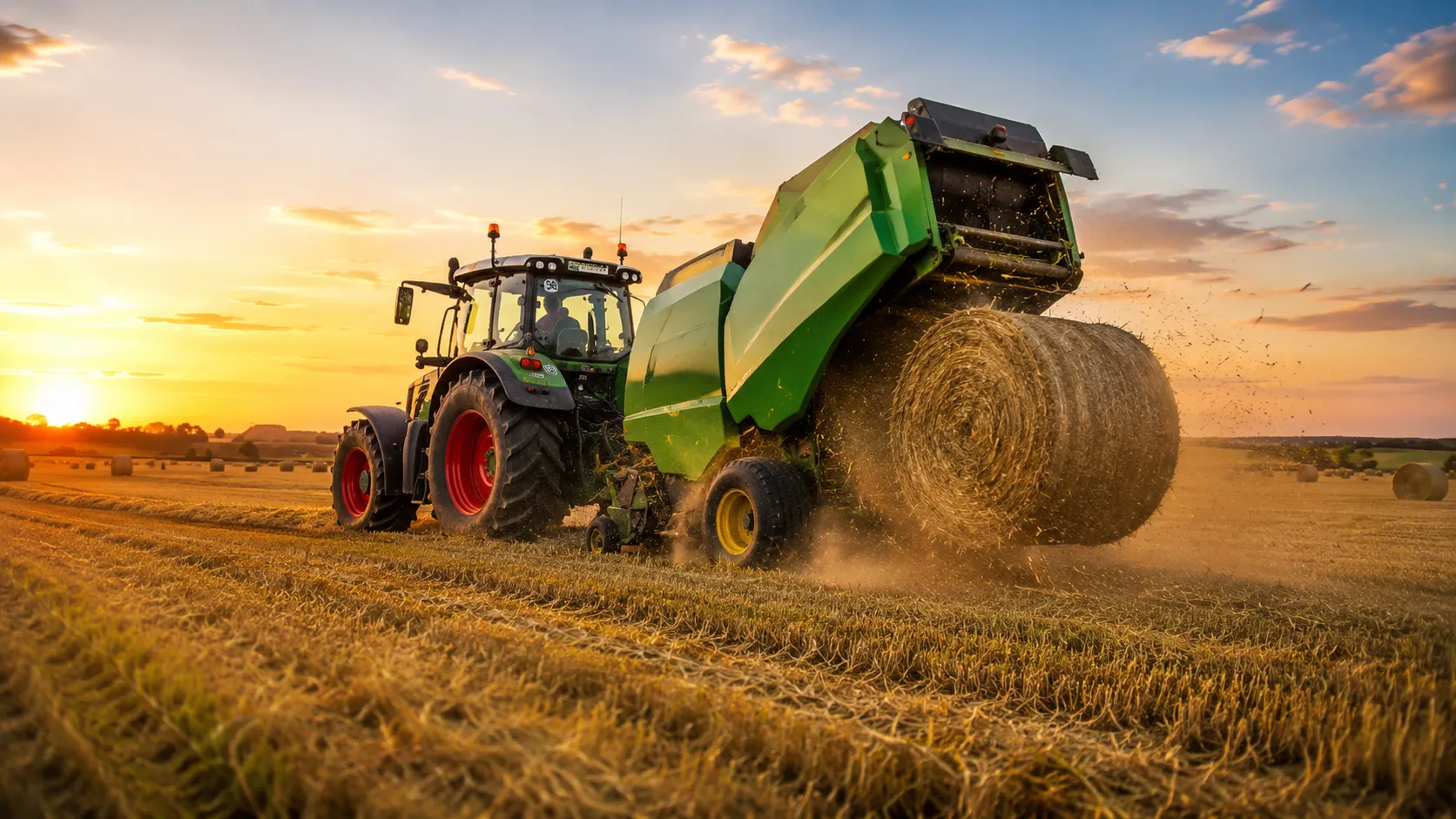
A square baler working in a raked windrow. For pine straw baling in the southeastern US, the small square format is the standard — the machine selection and setup details determine bale quality.
Pine straw baling is a significant niche market in the southeastern United States, particularly across the longleaf and slash pine growing regions of Georgia, Florida, North Carolina, South Carolina, and Alabama. The bales produced — typically small square format, 14 x 18 inches in cross-section — are sold to landscaping wholesalers, garden centers, and big-box retailers as premium decorative mulch. A single acre of pine forest floor can produce 150 to 300 bales of pine straw per harvest, with harvests typically conducted once or twice per year.
The pine straw baling market has well-established quality standards that differ from hay and straw baling in important ways. Understanding these standards — and which machines consistently produce bales that meet them — is the foundation of a commercially successful pine straw baling operation.
The Pine Straw Market in the Southeastern US
Pine straw mulch commands a premium price in the southeastern landscaping market for several reasons: it is aesthetically consistent with the regional landscape character, it is naturally acidic and benefits acid-loving plants like azaleas and blueberries, it is lighter than wood chip mulch for the same coverage area, and it interlocks when applied preventing wind displacement better than loose mulch alternatives.
The retail pine straw market is served almost entirely by small square bales. The standard retail bale contains approximately 2.5 to 3 cubic feet of pine needles and weighs 10 to 20 lbs depending on moisture and needle density. This bale format is dictated by the retail display standard — garden centers and big-box retailers display pine straw on pallets in small square bale format, and any bale that does not conform to the standard dimensions will not move through the retail channel.
Wholesale vs retail: two markets with different requirements
Wholesale pine straw buyers (landscaping companies, wholesalers) typically accept bales on a per-bale price basis and care primarily about consistency — uniform bale weight, tight binding with no loose needles falling out, and minimal soil or debris contamination. Retail buyers (garden centers, big-box retailers) have stricter visual standards — the bale must look clean and full on display without netting visible through the baling twine.
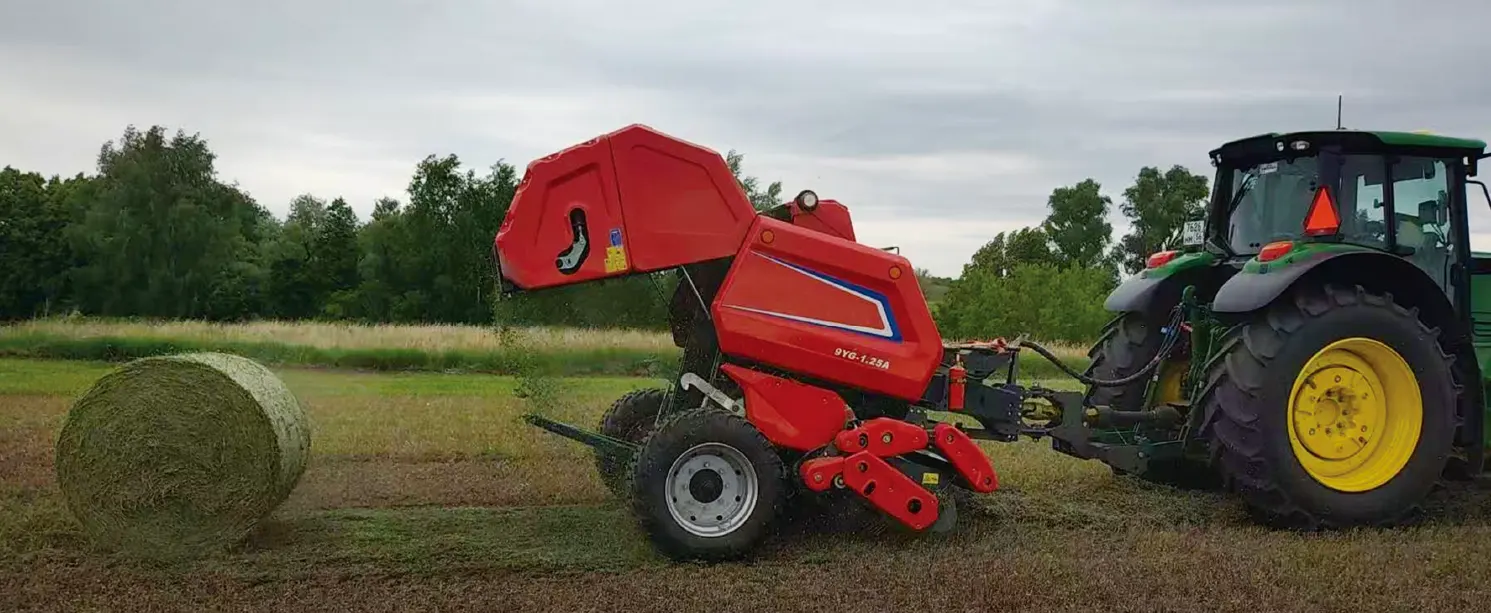
The small square baler format is the industry standard for pine straw baling in the southeastern US. The retail market requires consistent bale dimensions that only a properly calibrated small square baler produces reliably.
Which Baler Machines Work for Pine Straw
Pine straw baling requires a small square baler — the round baler format is not compatible with the southeastern retail market standard. Among small square balers, the machines that perform best on pine straw share three characteristics: a spring-tooth pickup with adjustable ground clearance, a twin D-type knotter system with reliable twine tension control, and a bale density adjustment that allows the operator to hit the target bale weight consistently.
The 9YF-1700 for pine straw baling
The 9YF-1700 small square baler is well-suited to pine straw baling operations. The 1700mm spring-tooth pickup handles pine needles at typical southeastern field moisture levels (8 to 14 percent) consistently, and the 460 x 360 mm bale chamber produces bales within the standard retail dimensions. The twin D-type knotter system provides reliable two-string binding essential for bales that will be displayed at retail.
Setup differences from hay and straw baling
Pine straw baling requires lower pickup height settings than hay baling — typically 0.5 to 1 inch (12 to 25 mm) off the ground, compared to 1 to 1.5 inches for hay. Pine needles are fine and lie close to the ground surface; insufficient pickup height leaves significant material behind. The pickup speed also needs to be set correctly — too fast and the fine needles skip over the tines; too slow and the pickup mechanism does not gather the needles cleanly from a flat surface.
Rake your pine straw windrows slightly wider than usual — 48 to 54 inches for a 67-inch pickup. This ensures the outer tines are always operating on material rather than dragging on bare ground, which reduces soil contamination in the bale and extends tine life. Pine needle contamination with soil is the single most common retail rejection reason.
Field and Machine Setup for Pine Straw Baling
Pickup height
Set pickup ground clearance to 12 to 25 mm (0.5 to 1 inch) for flat, level pine forest floor conditions. Check clearance at both ends of the pickup bar to ensure it is level. On uneven or rooty forest floor terrain, increase to 30 to 40 mm to prevent tine damage from root stubs. In pine straw baling, you will typically need to re-check and adjust pickup height more frequently than in hay baling because pine forest floors are more irregular than agricultural fields.
Bale density setting
Set the bale density compression spring to produce bales in the 12 to 18 lb range for wholesale markets, or 15 to 20 lb for retail markets where a fuller-looking bale commands better shelf presence. Avoid over-compressing — pine needle bales that are too dense are difficult to spread in the field and can crack the bale wrapper on the outside when compressed beyond the needle’s natural spring-back threshold.
Bale length setting
Standard retail pine straw bales are 36 to 40 inches long. Set the bale metering mechanism to produce bales within this range. Bales that are too short look thin on retail display and will be rejected by retail buyers. Bales that are too long do not fit standard display pallets and are difficult to stack uniformly.
| Setup parameter | Pine straw setting | Hay setting for comparison |
|---|---|---|
| Pickup height | 12-25 mm | 25-40 mm |
| Target bale weight | 12-20 lbs | 40-80 lbs |
| Bale length | 36-40 inches | 18-24 inches |
| Operating speed | 4-6 mph | 5-8 mph |
| Knotter lubrication | Every 8 hrs | Every 8-10 hrs |
Bale Quality Standards for the Retail Market
Retail pine straw buyers in the southeastern US have established quality standards that experienced pine straw producers understand instinctively. If you are new to the market, the following standards should be built into your machine setup and quality check process before delivering to any retail buyer.
- Bale weight consistency: retail buyers accept a tolerance of plus or minus 2 lbs from the agreed weight. Machine density setting drift across a long baling day will push bales outside this tolerance — re-check density after every 200 bales
- Binding: both twine strings must be tight and uniformly placed. Loose strings allow bales to sag and lose shape on retail display
- Soil contamination: visible soil in the bale surface is a common rejection reason. The pine needle color should be uniform brown or gray — soil appears as darker patches
- Green needle content: retail buyers typically specify less than 5 percent green needle content. Green needles indicate premature harvest — wait until the majority of needles have turned brown before baling
- Debris content: sticks, bark, and cones in the bale reduce visual quality. Use a debris rake pass before the windrow-forming rake pass to remove the largest debris from the forest floor
Raking and Windrow Preparation for Pine Straw
Windrow preparation is more important in pine straw baling than in hay or straw baling because the forest floor environment introduces debris, soil, and irregular surface contours that directly affect bale quality. A two-pass raking system — a debris collection pass followed by a windrow-forming pass — produces the cleanest bales and the highest retail acceptance rate.
Rake types for pine straw
Finger-wheel hay rakes are the standard tool for pine straw windrow formation in the southeastern US. The 9LZY-9.0 and 9LZD-9.0 finger-wheel rake models from Ever-Power are commonly used in pine straw operations for their ability to form uniform, low-ground-clearance windrows without picking up excessive debris from the forest floor.

A trailed finger-wheel hay rake forming windrows. For pine straw operations, the rake height and forward speed must be set to minimize debris pickup from the forest floor surface.
Windrow width for pine straw baling
Form pine straw windrows at 48 to 54 inches wide for a 1700mm (67-inch) pickup baler. This slightly narrower-than-pickup windrow width ensures the outer tines always operate over material, preventing the edges from dragging on the bare forest floor and picking up soil or root debris.
Pine Straw Baling Economics: What to Expect
Pine straw baling economics vary significantly by lease agreement structure, regional market price, and operation scale. The following estimates are indicative for a 500-acre pine straw operation in the southeastern US.
| Revenue and cost item | Per-acre estimate | Notes |
|---|---|---|
| Bale yield | 150-300 bales/acre | Varies by stand density and harvest frequency |
| Wholesale price per bale | $3.00 – $4.50 | Delivered to wholesaler |
| Retail price per bale | $5.00 – $8.00 | Requires retail relationship and quality consistency |
| Raking cost | $40 – $80/acre | Custom raking or owned equipment |
| Baling cost | $30 – $60/acre | Custom or owned equipment |
| Haul and delivery | $0.40 – $0.80/bale | Regional variable |
| Net margin (wholesale) | $150 – $350/acre | After raking, baling, and delivery |
At 500 acres per year at the mid-range net margin of $250 per acre, a pine straw operation generates approximately $125,000 per year before equipment ownership costs. Owning your own baling equipment versus using custom services improves margin by approximately $30 to $60 per acre — meaningful at scale and the primary driver of equipment ownership decisions in the pine straw industry.
- 9YF-1700 Small Square Baler — the standard machine for pine straw baling
- Small Square Baler for Sale — complete buying guide for US farm operations
- Tractor Baler Setup Guide — pickup height, PTO speed, and field configuration
- Hay Baler Machine Comparison — square vs round for US operations
- Straw Baler Machine Price Guide 2026 — complete FOB price reference
Frequently Asked Questions
What size baler is best for pine straw baling?
Pine straw requires a small square baler producing bales in the 14 x 18 inch cross-section, 36 to 40 inch length range — the standard format for the southeastern US retail market. The 9YF-1700 small square baler with 1700mm spring-tooth pickup is well-suited to pine straw baling operations. Round balers are not compatible with the retail pine straw market format.
How many pine straw bales can I produce per acre?
Output varies significantly by pine stand density, needle fall depth, and time since last harvest. A productive longleaf or slash pine stand harvested annually typically yields 150 to 300 bales per acre. Stands harvested less frequently may yield more per harvest but less per year. First-harvest bale yields are typically higher than subsequent harvests from the same stand.
What pickup height should I use for pine straw baling?
Set pickup ground clearance to 12 to 25 mm (0.5 to 1 inch) for flat pine forest floor conditions. Pine needles lie very close to the ground — insufficient pickup height is the most common cause of poor collection efficiency and high material losses behind the baler. On rooty or irregular forest floor terrain increase to 30 to 40 mm to protect tines from damage.
Can I use the same baler for pine straw and hay on the same farm?
Yes. The 9YF-1700 handles both pine straw and hay crops without mechanical modification. The setup adjustments between crops are pickup height (lower for pine straw), bale density setting (lighter for pine straw), and bale length (shorter for pine straw). Both adjustments are mechanical settings that take 10 to 15 minutes to change between crop types.
What moisture level should pine straw be at before baling?
Pine straw bales best at 8 to 14 percent moisture. Above 16 percent moisture the bales will compress too tightly and the needles will mat together — producing a product that is difficult for end users to spread. Below 8 percent the needles become brittle and fine material loss through the baler increases. Bale in the morning or early afternoon after any dew has dried from the surface of the windrow.
Tell us your tractor HP, primary crop, and approximate seasonal bale volume. We send a matched model recommendation and factory-direct price — no sales pressure, no intermediary margin.