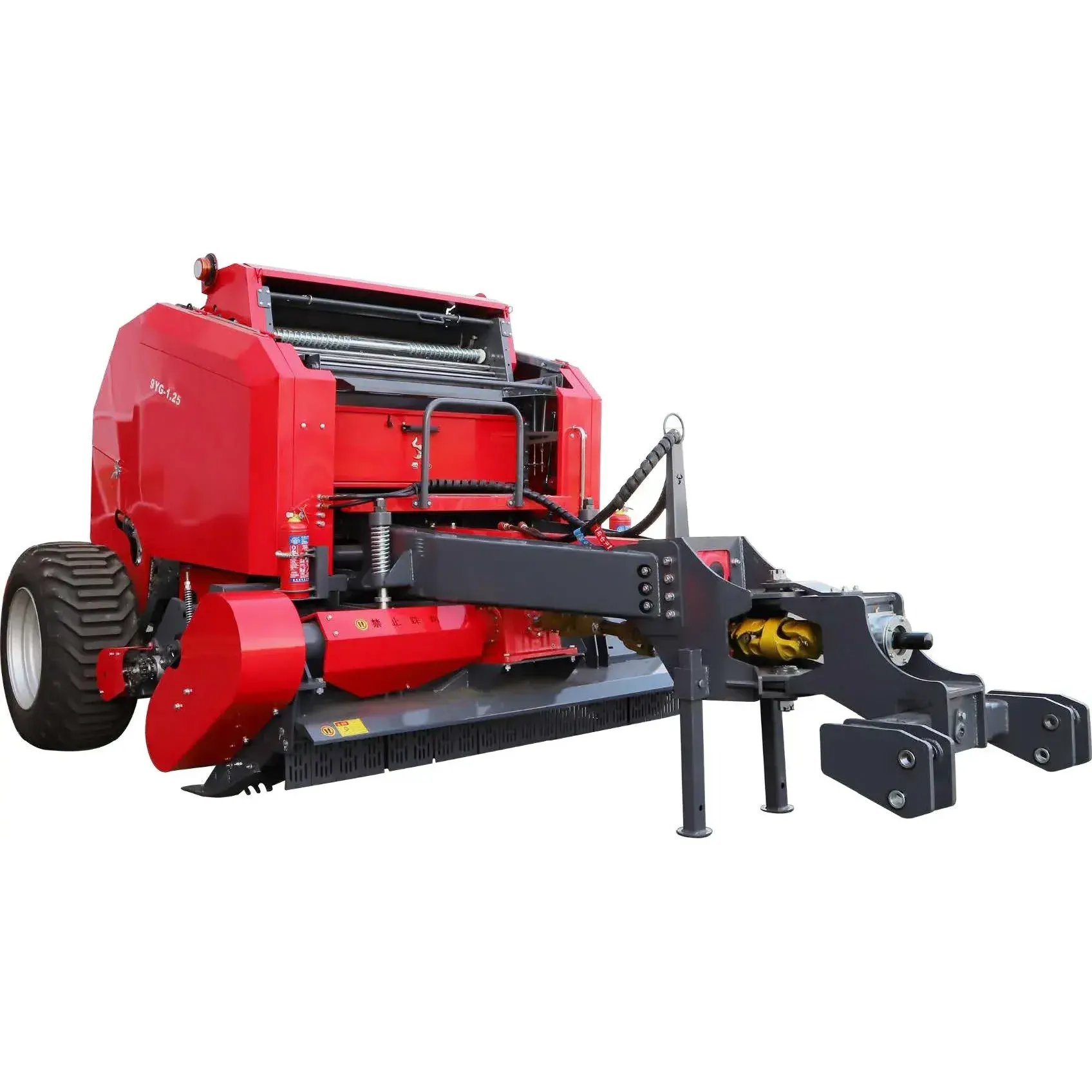
Round bales in field storage. Moving them efficiently without damaging the film wrap or bale structure requires the right transporter design — not just any tractor attachment.
Once you have produced wrapped round bale silage or net-wrapped hay bales, the next challenge is moving them from the field to storage without damaging the stretch film or net wrap that protects them. A bale spear on a loader tractor works for moving one bale at a time in a short distance — but for operations moving hundreds of bales per season across fields to centralized storage, a dedicated round bale transporter dramatically reduces the labor and time cost of the post-baling logistics step.
This guide covers the two round bale transporter models in the Ever-Power range — the EP-9JYY-2.5 (2.5-tonne capacity) and the 9JYY-4.5 (4.5-tonne capacity) — and walks through how to match the right transporter to your baler output, tractor capacity, and field-to-storage distance.
Why a Dedicated Round Bale Transporter Matters
Moving round bales with a loader tractor and single bale spear is effective for small operations — 20 to 40 bales per season — where the time investment per bale is acceptable. For operations producing 200 or more round bales per season, single-bale handling becomes the bottleneck in the post-harvest logistics chain. A baler that produces 40 bales per hour cannot be followed by a transport system that moves one bale every 3 to 5 minutes.
A dedicated round bale transporter picks up multiple bales in a single pass and transports them to a storage location in a single tractor trip. This multiplies the effective transport rate by the number of bales carried per trip — typically 3 to 6 bales depending on the transporter model and bale size. For silage bales where film protection during transport is critical, the transporter’s pickup and cradle design also determines whether film damage occurs at the bale contact points.
Film damage: the hidden cost of inadequate transport
Silage bales with punctured, torn, or abraded stretch film lose their oxygen exclusion at the damage point. Aerobic spoilage then progresses outward from the damage location, creating a spoilage zone that represents lost silage volume and reduced feed value. Transporting wrapped silage bales on a steel bale spear, over rough field terrain, at road transport speeds, produces exactly the kind of film abrasion that causes this problem. A transporter with padded or rubber-lined cradles eliminates this mechanism of film damage.
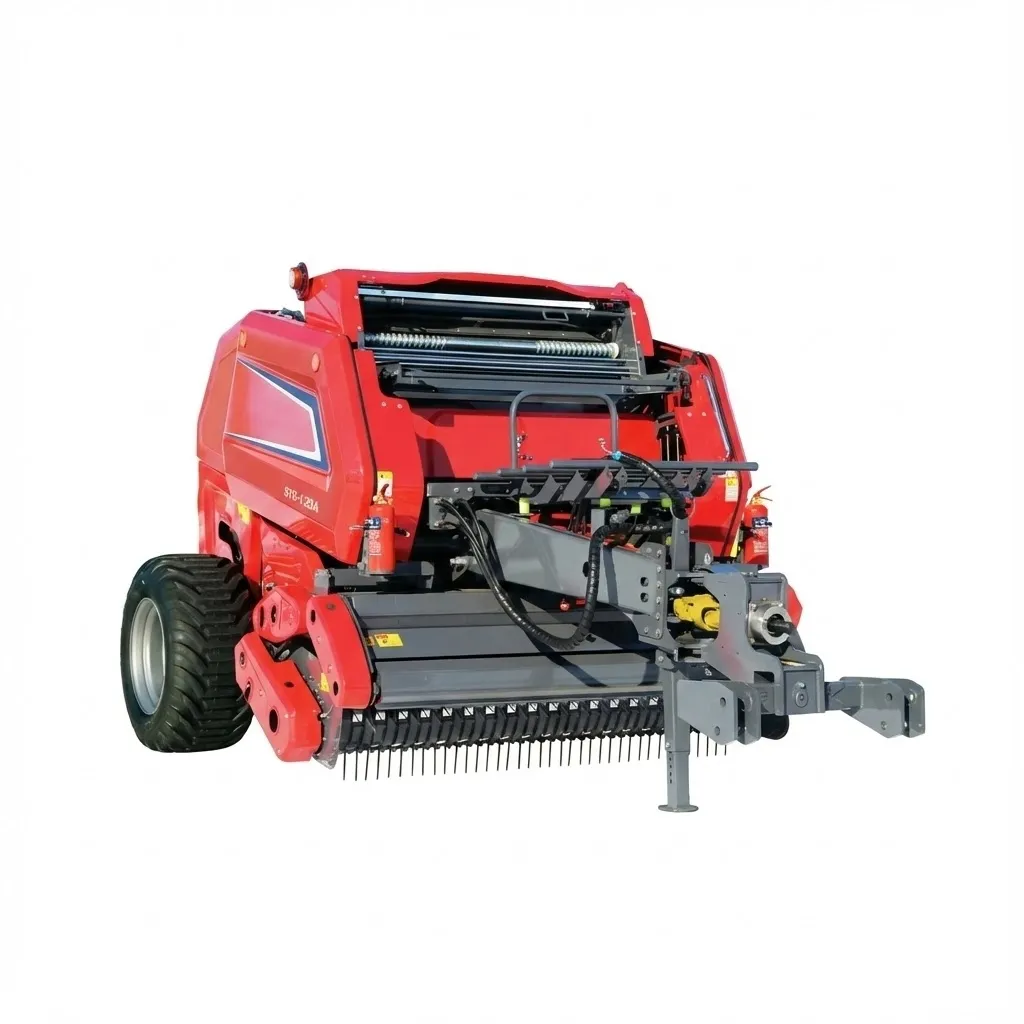
A-type frame round bale pickup design on the 9JYY transporter. The pickup arms engage the bale from both sides without a center spike, eliminating the film puncture risk of a standard bale spear.
EP-9JYY-2.5 and 9JYY-4.5: The Two Transporter Models
EP-9JYY-2.5: the compact transporter
The EP-9JYY-2.5 is a trailed round bale pickup transporter with a 2.5-tonne maximum load capacity. It is designed for operations moving 9YG-1.0 compact round baler bales (approximately 700 to 900 lbs per bale), accommodating 2 to 3 bales per trip depending on bale weight and field conditions.
| Specification | EP-9JYY-2.5 |
|---|---|
| Max load capacity | 2.5 tonnes (5,500 lbs) |
| Bale pickup | Hydraulic pickup arms — trailed design |
| Bale capacity | 2-3 round bales (9YG-1.0 size) |
| Compatible balers | 9YG-1.0, 9YG-1.25 compact models |
| Transport width | Compact for road use |
| Min. tractor HP | 40 HP |
9JYY-4.5: the high-capacity transporter
The 9JYY-4.5 is the larger transporter model with 4.5-tonne maximum load capacity, designed to follow the 9YG-2.24D large round baler or any commercial round baler producing large-format bales. It accommodates 3 to 5 bales per trip depending on bale weight.
| Specification | 9JYY-4.5 |
|---|---|
| Max load capacity | 4.5 tonnes (9,900 lbs) |
| Bale pickup | Hydraulic pickup with A-frame arms |
| Bale capacity | 3-5 round bales (9YG-2.24D size) |
| Compatible balers | 9YG-2.24D and large commercial round balers |
| Transport width | Check local road width limits |
| Min. tractor HP | 65 HP |
Film Protection During Transport: The Critical Design Difference
The contact points between the transporter and the bale are where film damage occurs during transport. The two primary risk points are the pickup mechanism and the bale cradle surface.
Pickup mechanism design
Both the EP-9JYY-2.5 and 9JYY-4.5 use hydraulic pickup arms that engage the bale from the sides rather than a center spike that punctures through the film at the end of the bale. This A-frame or clamshell pickup design distributes the engagement force across a larger contact area and eliminates the puncture risk inherent in a single-point bale spear.
Cradle surface
The bale cradle on both transporter models is designed with rubber-lined or padded contact surfaces at the points where the bale rests during transport. This prevents the abrasion that occurs when a wrapped bale moves against bare steel during road transport vibration. Film abrasion from metal contact surfaces is the most common cause of silage bale film failure that does not show up until the bale is opened in storage weeks or months after the damage occurred.
After each field-to-storage transport run, inspect every bale’s film surface for cuts, abrasion marks, or areas where the film has stretched beyond its elastic limit. Minor surface abrasion that does not penetrate all film layers typically reseals itself under tension — mark these bales for priority use and consume them first in the feed rotation.
Field-to-Storage Workflow with a Round Bale Transporter
The most efficient field-to-storage workflow for round bale silage or hay operations using a transporter integrates the pickup and transport steps with the baling operation rather than treating them as separate post-baling activities.
In-field workflow
The most efficient single-tractor operation uses the baling tractor to both produce the bales and transport them — possible when the baler can be disconnected from the PTO and the transporter hitched in the field between baling sessions. This requires bales to be left in the field in a location where the transporter can pick them up after the baling run is complete.
Two-tractor workflow
For larger operations where a dedicated transport tractor is available, the baler and transporter can operate simultaneously — the baler produces bales in the field while the transport tractor follows behind, picking up bales and moving them to storage continuously. This workflow eliminates the field staging step and maximizes baler utilization by removing bales from the field as fast as they are produced.
Storage layout planning
Design the storage layout before baling begins. Round bale rows should be spaced at least 12 to 18 inches apart for air movement around the bales. Elevation — stored on slightly higher ground than the surrounding area — allows drainage away from the bale contact points. Contact with soil moisture is the leading environmental cause of wrapped silage bale deterioration in outdoor storage.
Large round bales staged in field before transporter pickup. Stage bales in rows parallel to the transport direction to minimize transporter turns and maximize pickup efficiency per tractor hour.
Matching the Round Bale Transporter to Your Tractor
The EP-9JYY-2.5 requires a minimum of 40 HP — compatible with most mid-class farm tractors used for round baler operations. The 9JYY-4.5 requires a minimum of 65 HP, reflecting the higher hydraulic demand of the larger pickup arms and the greater drawbar load of a full 4.5-tonne transport load.
Both transporters use the tractor’s hydraulic remote coupler for the pickup arm actuation. Confirm your tractor has at least one remote hydraulic output available — or two if the tractor is also being used for the baler during the same operating session. Most tractors in the compatible HP range have two remote outputs as standard.
Road transport considerations
Both transporter models have transport widths that require attention on public roads. Check local regulations for agricultural transport width limits in your state before operating on public roads. For operations where farm-to-storage transit involves public road sections, confirm that the loaded transporter width and height comply with your state’s oversize load requirements or permits.
The 9JYY-4.5 at full 4.5-tonne load places significant axle load on the transport trailer. Verify that the road surfaces between your field and storage location can support the combined tractor and loaded transporter weight. Gravel access roads and soft shoulders are common field access route limitations — assess before the first transport run of the season.
- 9YG-1.0 Compact Round Baler — the baler matched with the EP-9JYY-2.5 transporter
- 9YG-2.24D Large Round Baler — the baler matched with the 9JYY-4.5 transporter
- 9YCM-850 Baler Wrapper Combination — one-pass silage system
- Baler Wrapper Combo Guide — integrated silage system for US livestock farms
- Round Baler for Sale — evaluation guide for any round baler listing
Frequently Asked Questions
What is the capacity of the EP-9JYY-2.5 round bale transporter?
The EP-9JYY-2.5 has a maximum load capacity of 2.5 tonnes (approximately 5,500 lbs). For 9YG-1.0 compact round bales weighing 700 to 900 lbs each, this translates to 2 to 3 bales per transport trip. The hydraulic pickup arms engage bales from the side without a center spike, protecting wrapped silage film from puncture during pickup.
What tractor HP is needed for the 9JYY-4.5 round bale transporter?
The 9JYY-4.5 requires a minimum of 65 HP at the tractor PTO for hydraulic system operation. It also requires one remote hydraulic valve set for pickup arm actuation. For road transport with a full 4.5-tonne load, verify that the tractor’s drawbar pull and braking capacity are adequate for the loaded transport weight at your typical road speeds.
Can I use a standard bale spear instead of a dedicated round bale transporter for silage bales?
A standard bale spear moves one bale per tractor trip and concentrates the pickup force at a single penetration point through the stretch film — a puncture risk on every silage bale handled. For operations moving 20 or fewer silage bales per season a single bale spear is acceptable. For larger operations, a dedicated transporter with side-engagement pickup arms eliminates both the film damage risk and the handling time bottleneck of single-bale transport.
How far from the field can I transport round bales with the EP-9JYY-2.5?
The EP-9JYY-2.5 is designed for field-to-farm transport over typical farm access roads. There is no defined maximum transport distance — the practical limit is the road surface condition, the local road width regulations, and the tractor’s comfortable operating speed under load. For transport distances over 3 to 5 miles, assess whether truck transport of multiple bales on a flat-bed trailer is more cost-effective than multiple tractor-transporter runs.
Does the round bale transporter work with both hay bales and silage bales?
Yes. Both the EP-9JYY-2.5 and the 9JYY-4.5 handle hay bales, straw bales, and wrapped silage bales without modification. The rubber-lined cradle surfaces are beneficial for silage bale film protection but do not affect the handling of net-wrapped hay bales. The hydraulic pickup arm design is compatible with both net-wrapped and twine-tied round bales.
Tell us your tractor HP, primary crop, and approximate seasonal bale volume. We send a matched model recommendation and factory-direct price — no sales pressure, no intermediary margin.