
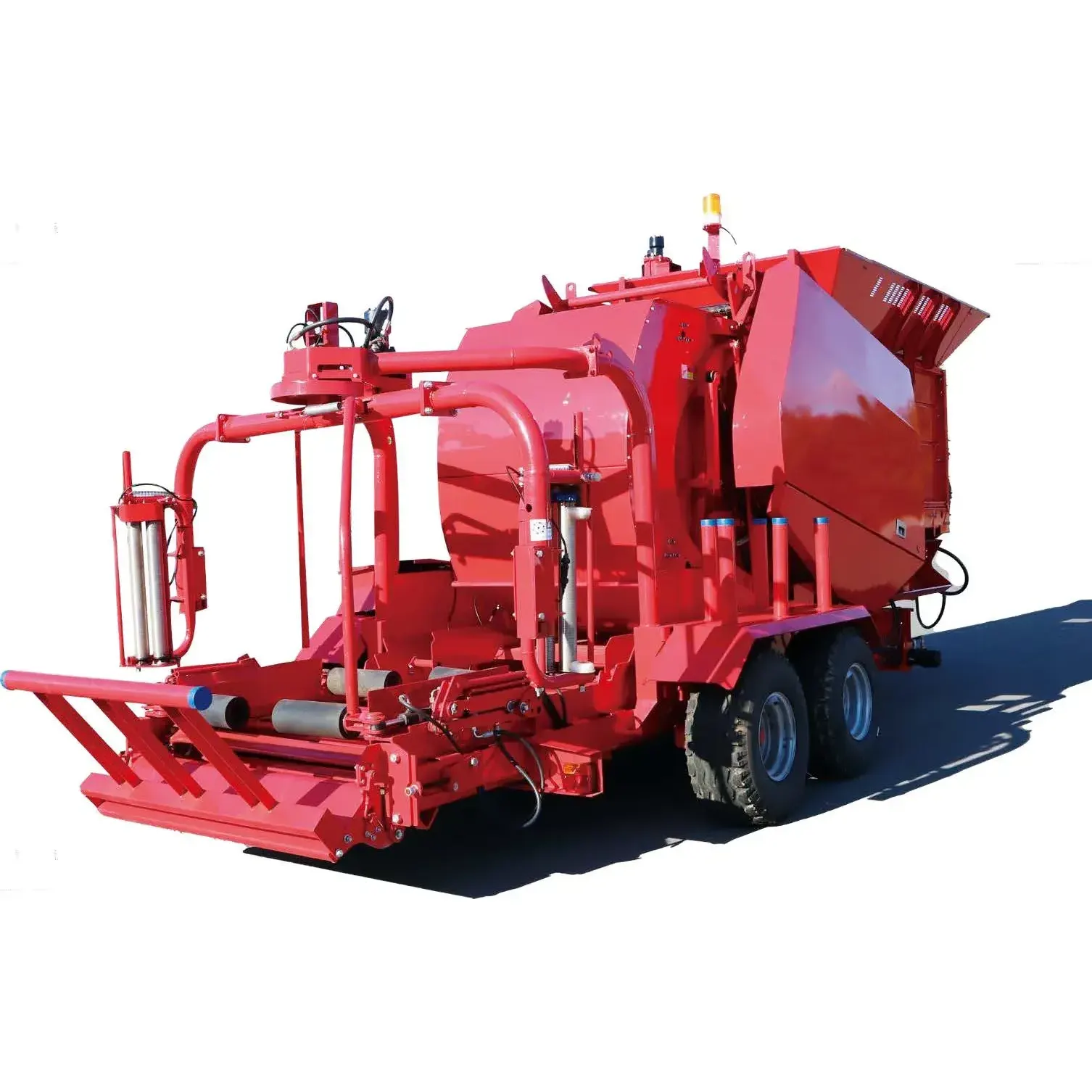
The 9YCM-850 integrated round baler and wrapper combination. One tractor, one pass, sealed silage bales — this is the one-pass system for US livestock operations prioritizing silage quality and labor efficiency.

Wrapped round bale silage has become one of the most widely adopted forage preservation methods on US livestock farms over the last decade — flexible, lower capital than bunker silos or silage piles, and compatible with small to medium herds that do not generate the volume needed to justify large silo infrastructure. The traditional workflow involves two machines: a round baler and a separate bale wrapper, typically operated with two tractors and two operators.
The integrated baler wrapper combination — specifically the 9YCM-850 — eliminates the second machine, second tractor, and second operator by wrapping each bale with stretch film the moment it is ejected from the baling chamber. This is not a marginal improvement on the two-machine process. It changes the fundamental economics of silage production by reducing direct labor cost by 40 to 50 percent and eliminating the most critical quality risk in wrapped bale silage production: the window between baling and oxygen exclusion.
Why an Integrated Baler Wrapper Changes the Economics
The economic case for an integrated baler wrapper combination versus a two-machine system rests on four factors: labor cost, silage quality, equipment investment, and operational simplicity.
Labor cost
A two-machine silage system requires a baler operator and a wrapper operator — two tractors, two people, two sets of operating costs. An integrated system requires one tractor and one operator for the complete baling-and-wrapping cycle. For US livestock farms where hired labor costs $18 to $28 per hour, eliminating one operator across a 200-hour silage season saves $3,600 to $5,600 in direct labor cost — meaningful against the purchase price of the integrated system.
Silage quality
The interval between baling and wrapping is the highest-risk period in wrapped bale silage production. During this window, the bale is exposed to oxygen and the fermentation process runs aerobically — consuming sugars that should be preserved as lactic acid and generating heat that degrades protein quality. Research consistently shows that bales wrapped within 2 to 4 hours of production have higher dry matter digestibility, lower pH, and better fermentation quality scores than bales wrapped 12 to 24 hours after baling. The integrated system reduces this window to seconds.
Equipment investment
The 9YCM-850 at $25,000 to $32,000 FOB costs more than a standalone round baler. But compared to the total investment of a standalone round baler plus a quality bale wrapper plus the second tractor, the integrated system often represents a lower total capital outlay for operations that do not already own a second tractor. Calculate the comparison based on your specific situation.
The 9YCM-850 satellite ring wrapper applies stretch film immediately as the bale exits the baling chamber. The wrapping begins before the bale has left the machine — oxygen exclusion within seconds of formation.
9YCM-850 Specifications and Output
The 9YCM-850 integrated round baler and wrapper is the most advanced silage system in the Ever-Power product range. It combines a fixed-chamber round baler with a high-speed satellite ring wrapping system in a single machine pulled by one tractor.
| Specification | 9YCM-850 Detail |
|---|---|
| Bale diameter | 33-35 inches (85-90 cm) |
| Bale length | 33 inches (85 cm) |
| Output rate | 30-40 bales per hour |
| Min. tractor HP | 120 HP (88 kW) |
| PTO speed | 540 rpm |
| Control system | Fully electronic with load sensor density control |
| Hydraulic requirement | Two remote valve sets minimum |
| Film layers | 4-6 layers (adjustable) |
| Film type | Standard 500mm x 25 micron stretch film |
| FOB price range | $25,000 – $32,000 |
Electronic density control system
The 9YCM-850 uses load sensors to monitor the bale formation process and automatically signal the operator when target density is reached. This eliminates the bale-to-bale density variation that occurs when operators visually estimate bale fullness — an important consideration for silage operations where consistent bale weight directly affects ration feeding accuracy.
Film layer control
The satellite ring wrapper applies 4 to 6 layers of 25-micron stretch film in a programmable number of passes. The operator can set the film layer count from the tractor cab. Higher layer counts improve oxygen exclusion and extend storage life but increase film consumption cost. The standard recommendation for wrapped round bale silage is 4 layers minimum — the 9YCM-850 applies them consistently without the operator variation that affects manual wrapper operation.
Silage Quality: Why Oxygen Exclusion Speed Matters
The chemistry of silage fermentation is simple but time-sensitive. When forage is cut and baled at high moisture (60 to 70 percent), it contains a mixture of aerobic bacteria (which consume sugars in the presence of oxygen) and lactic acid bacteria (which produce the lactic acid that preserves the silage under anaerobic conditions). The race between these two bacterial populations is determined by how quickly oxygen is excluded from the bale.
Every hour the bale sits exposed to oxygen before wrapping, aerobic bacteria consume sugars that should be preserved as lactic acid. This reduces the final silage pH, increases heating in the bale, and reduces the dry matter digestibility of the finished product. For a dairy operation where silage quality directly affects milk yield, a 5 percent reduction in dry matter digestibility translates to a measurable reduction in milk production per cow per day.
Research published in the Journal of Dairy Science and reviewed by US extension agronomists consistently shows that bales wrapped within 2 hours of production achieve significantly better fermentation quality scores than bales wrapped at 12 or 24 hours. The integrated 9YCM-850 system reduces the wrap window to under 60 seconds — the time between bale ejection and film completion. No two-machine system can match this.
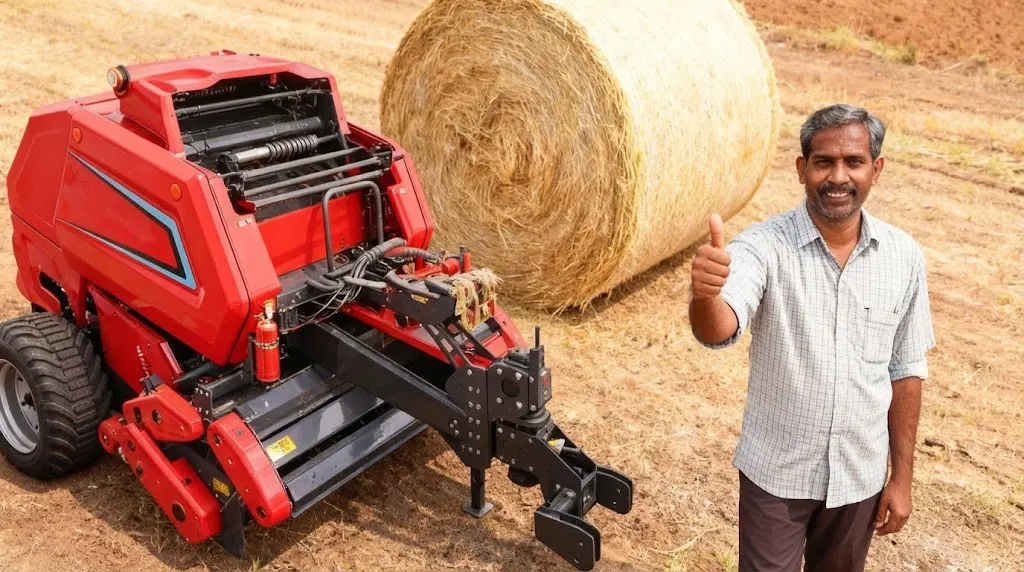
A livestock operation using wrapped round bale silage. The consistency of silage quality between batches is the most commercially important characteristic for operations feeding to a fixed ration formula.
Two-Machine vs Integrated: The Cost Comparison for a US Livestock Farm
The following comparison assumes a 200-head dairy operation producing 500 acres of corn silage per year. Costs are illustrative and will vary by region and equipment configuration.
| Cost item | Two-machine system | 9YCM-850 integrated |
|---|---|---|
| Equipment investment | $22,000-30,000 (baler + wrapper) | $29,500-38,500 (landed) |
| Second tractor requirement | Yes — additional $30,000-80,000 | No |
| Operator labor (200 hrs/season) | 2 operators x $22/hr x 200 hrs = $8,800 | 1 operator x $22/hr x 200 hrs = $4,400 |
| Film consumption | Standard — 2 machines | Standard — same film rate |
| Silage quality | Depends on wrap timing discipline | Consistently high — seconds wrap time |
| 5-year labor saving | Baseline | $22,000 saved |
The labor saving alone over 5 seasons ($22,000 at the above rates) covers most or all of the price premium of the integrated system over a standalone baler. When you add the second tractor cost that the integrated system eliminates, the total cost comparison typically favors the integrated system for operations that do not already own a second suitable tractor.
Which US Livestock Farms Should Buy the Integrated System
The 9YCM-850 integrated baler wrapper combination is the right choice for the following operation profiles. If your operation does not fit these profiles, a standalone round baler with a separate wrapper is likely the more appropriate choice.
Dairy operations over 150 head
At 150 head or more, silage quality consistency becomes commercially material — variation in silage quality directly affects milk yield and ration balancing accuracy. The integrated system’s consistently high silage quality score justifies the premium investment.
Beef operations with silage-dependent winter feeding
Beef operations in northern US states where cattle are kept on silage for 4 to 6 months per year benefit from the same silage quality consistency argument. Lower quality silage from delayed wrapping means higher supplemental feed cost to maintain target daily gain rates.
Custom silage contractors
Custom silage contractors serving multiple farms benefit from the operational simplicity of the one-tractor system, the labor cost saving, and the ability to market a demonstrably higher silage quality product to clients. The integrated system is a business differentiation tool as much as a production cost reducer.
Operations with labor availability constraints
US farms where finding reliable seasonal silage labor is difficult benefit from the integrated system’s single-operator requirement. A skilled tractor operator running the 9YCM-850 can produce the same output as two operators in a two-machine system — a significant advantage when experienced agricultural labor is scarce in your area.
CAD engineering at the Ever-Power facility. The 9YCM-850 electronic control system and satellite wrapper timing require precise engineering tolerances — inspect manufacturer engineering capability before purchasing.
- 9YCM-850 Integrated Round Baler and Wrapper — full specifications and pricing
- 9YG-2.24D Large Round Baler — standalone round baler for two-machine silage systems
- Silage Baler Machine Guide — round baler vs square baler for dairy farms
- Mini Round Baler Guide — compact round baler for small US farm operations
- Straw Baler Machine Price Guide 2026 — complete price reference
Frequently Asked Questions
What is the minimum tractor HP for the 9YCM-850 baler wrapper combination?
The 9YCM-850 requires a minimum of 120 HP (88 kW) at the PTO. It also requires two remote hydraulic valve sets — one for baler functions and one for the satellite wrapper ring drive. Confirm your tractor has both remote hydraulic outputs available before ordering. Many mid-class tractors in the 120 HP range have only one remote output — check your tractor specification sheet.
How many film layers does the 9YCM-850 apply per bale?
The film layer count is operator-programmable between 2 and 8 layers. The standard recommendation for wrapped round bale silage is 4 layers minimum of 25-micron stretch film. The 9YCM-850 applies layers consistently at the programmed count — eliminating the variation that occurs in manual wrapper operation. Increase to 6 layers for bales stored outdoors on uneven terrain where physical damage is more likely.
What is the output rate of the 9YCM-850 in bales per hour?
The 9YCM-850 produces 30 to 40 bales per hour in typical field conditions — combining the baling and wrapping cycle in a single continuous operation. Each bale takes 90 to 120 seconds to form in the baler plus 30 to 60 seconds to wrap, with the tractor continuing to travel during wrapping. The effective field output is comparable to a standalone round baler without the wrapping delay.
Can the 9YCM-850 handle corn silage as well as grass silage?
Yes. The 9YCM-850 handles any silage crop that the round baler’s pickup mechanism can gather. For corn silage the crop should be harvested at 60 to 70 percent moisture and the machine’s density setting adjusted for the heavier material. Corn silage at optimal moisture bales more uniformly than high-fibre grass silage — bale weights are more consistent and density sensor performance is more accurate.
Is the 9YCM-850 available with factory-direct pricing for US buyers?
Yes. Ever-Power offers factory-direct purchasing on the 9YCM-850 for US buyers. FOB factory price range is $25,000 to $32,000. Landed US cost with standard sea freight and customs clearance is approximately $29,500 to $38,500 depending on destination state and freight routing. Contact us at [email protected] for a specific landed cost quote to your farm.
Tell us your tractor HP, primary crop, and approximate seasonal bale volume. We send a matched model recommendation and factory-direct price — no sales pressure, no intermediary margin.