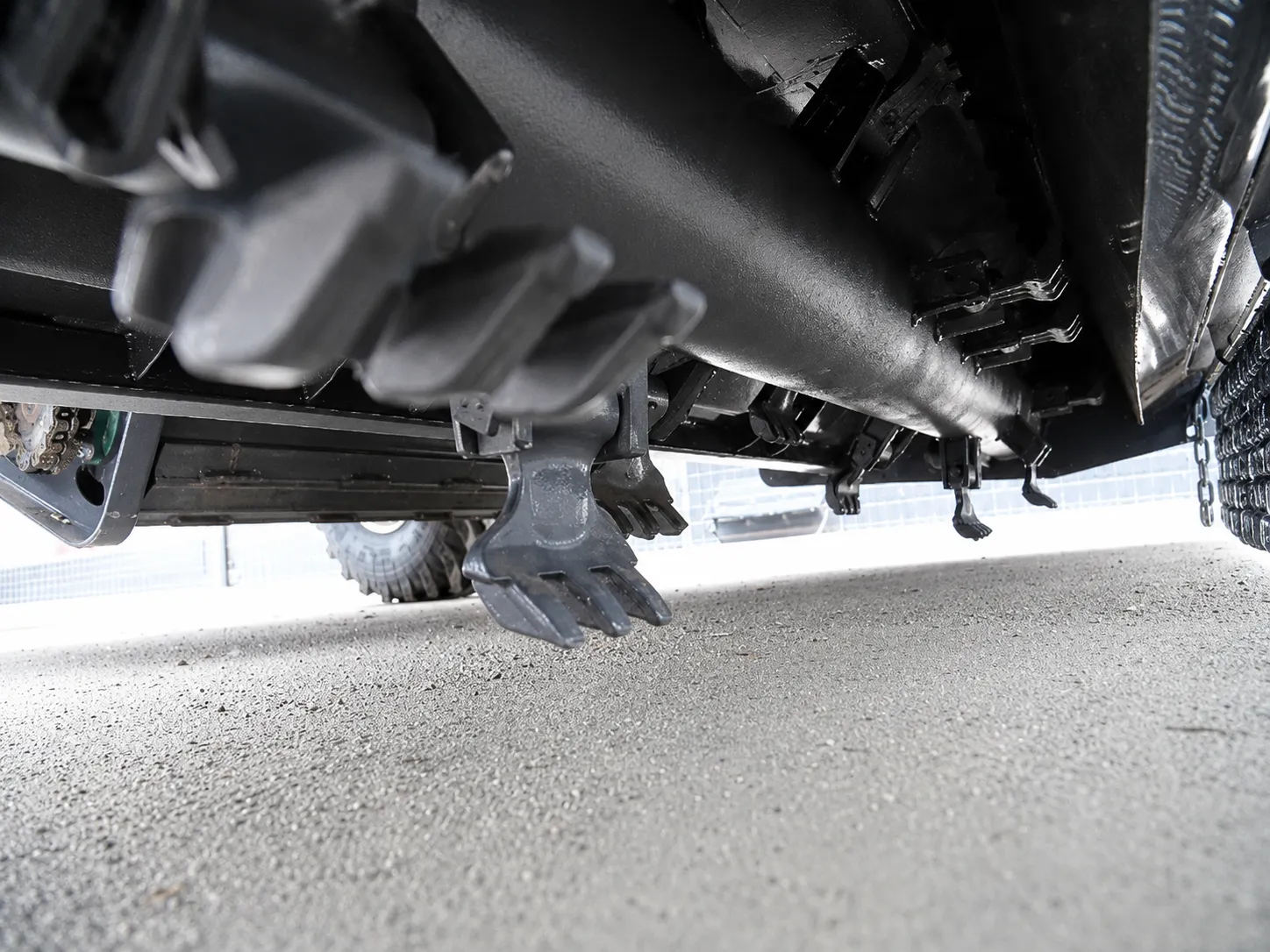
The hammer-claw pickup mechanism on the 9YF-2200S corn stalk baler with shredder. This is the engineering solution that works where standard spring-tooth pickups fail on standing corn residue.
Corn stalk baling in the US Corn Belt has grown substantially as a practice over the last decade, driven by biomass energy demand, livestock bedding markets, and the growing interest in soil organic matter management through partial residue removal. The challenge that every buyer new to the category discovers quickly is that standard square balers with spring-tooth pickups are not the right tool for the job — they jam on standing stalks, produce inconsistent bale density, and generate maintenance costs that make the operation uneconomical within one season.
The correct machine for commercial corn stalk baling is a square baler with an integrated shredder mechanism — specifically the 9YF-2200S in either single-crusher or dual-crusher configuration. This guide explains why, what the specifications look like, and how to match the right configuration to your specific end use and field conditions.
Why Corn Stalk Baling Requires a Shredder Mechanism
Corn stalks after harvest stand at 30 to 90 degrees from vertical in most field conditions. A combine-harvested corn field leaves standing stubble 6 to 14 inches tall — depending on combine header height settings — plus fallen but tangled stalks in the interrow areas. This combination of standing, lodged, and tangled material is fundamentally incompatible with the spring-tooth pickup mechanism used on standard square balers.
The spring-tooth pickup tine is designed to sweep flat, low-profile material from the ground surface. It works by pushing the tine down and back in a raking motion — effective on windrowed straw or hay but unable to engage standing stalks. On a corn stalk field, spring-tooth tines either bend the stalks without picking them up, or catch the base of the stalk and cause a pickup mechanism blockage within minutes of operation.
The shredder mechanism’s three functions
- Knock down standing stalks: the rotating hammer-claw arms strike the base and midsection of standing stalks, knocking them horizontal for the pickup mechanism to gather
- Chop to manageable length: the impact chops the stalk into segments typically 4 to 8 inches long, which enter the pre-compression channel more uniformly than whole stalks
- Feed consistently: the chopped, knocked-down material feeds through the pre-compression channel more evenly than whole stalks, producing more consistent bale density and reducing knotter failure from density variation
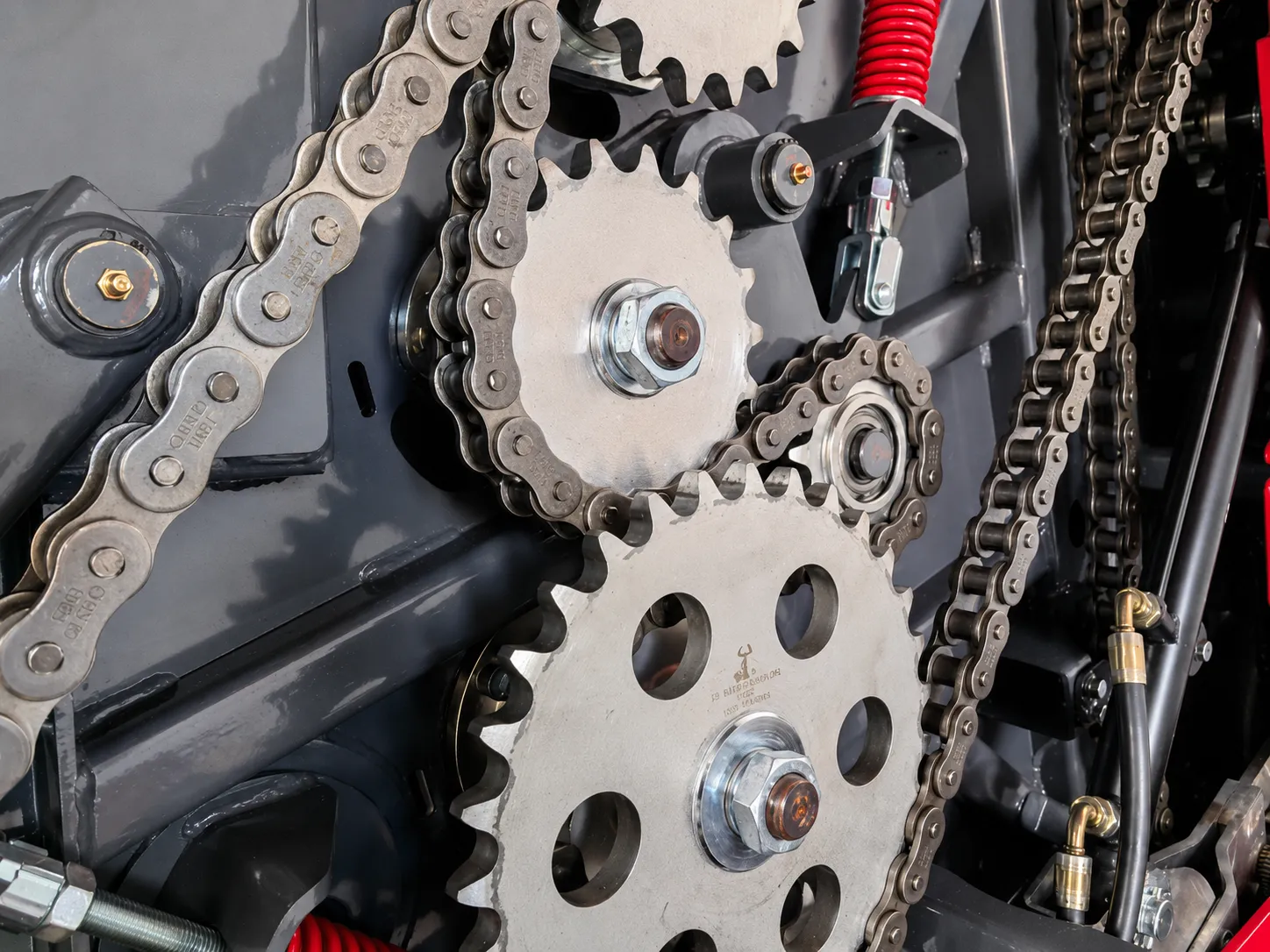
The 20A heavy-duty chain drive on the shredder mechanism. This is a higher specification than standard square baler drive components — essential for the higher torque load of the shredder mechanism on dense corn stalks.
Single-Crusher vs Dual-Crusher: What Actually Changes
The 9YF-2200S is available in two configurations that share the same basic shredder architecture but differ in the number of processing stages and the dust management system. The choice between single and dual crusher is driven by end use, not field conditions.
Single-crusher configuration
One stage of hammer-claw shredding before the compression chamber. Produces bales with moderate fiber length reduction — suitable for biomass fuel, livestock bedding, and general crop residue management. The single-crusher is the most common configuration for US Corn Belt operations where the primary end use is biomass energy production or corn stover removal for soil management.
Dual-crusher configuration
Two stages of hammer-claw shredding plus a negative-pressure dust removal fan that actively pulls leaf dust and fine particles out of the material stream before compression. This produces significantly cleaner bales with shorter average fiber length — required for TMR (Total Mixed Ration) dairy feeding, high-quality silage production, and commercial corn stover pelletizing operations where impurity content directly affects product value.
| Specification | 9YF-2200S Single | 9YF-2200S Dual |
|---|---|---|
| Shredder stages | 1 | 2 |
| Dust removal | Standard airflow | Negative-pressure fan system |
| Min. tractor HP | 100 HP | 110 HP |
| Machine weight | 2,350 kg | 2,350 kg |
| Crop moisture range | 10 – 23% | 10 – 28% |
| Bale cleanliness | Good — biomass and bedding grade | High — feed and pellet grade |
| FOB price range | $9,500 – $12,500 | $11,000 – $14,500 |
If the bales will be fed directly to dairy cattle or processed into silage or pellets, the single-crusher configuration produces too high an impurity content for premium feed markets. The negative-pressure dust removal fan in the dual-crusher configuration is not an optional upgrade — it is a fundamental quality requirement for feed-grade corn stover bales.
Full Specifications: 9YF-2200S Corn Stalk Baler with Shredder
| Specification | Detail |
|---|---|
| Pickup width | 2200mm hammer-claw shredder |
| Min. tractor HP | 100 HP (single) / 110 HP (dual) |
| Machine weight | 2,350 kg |
| PTO speed | 540 rpm |
| Max. field slope | 8 degrees |
| Crop moisture | 10-23% (single) / 10-28% (dual) |
| Suitable crops | Corn stalk, sorghum stalk, cotton stalk, sunflower stalk |
| Bale chamber | Standard square format |
| Certification | CE and ISO 9001 certified |
| FOB price | $9,500-12,500 (single) / $11,000-14,500 (dual) |
The 100 HP minimum for the single-crusher is substantially higher than the 50 HP minimum for the standard 9YF-2200 with spring-tooth pickup. This reflects the additional power demand of the hammer-claw shredder mechanism — particularly in dense, high-moisture corn stalk conditions early in the harvest season. Do not attempt to run the 9YF-2200S behind a tractor below 100 HP. Stalling the shredder mechanism on a dense corn stalk field generates shock loads that can damage the gearbox input shaft.
End-Use Applications: Matching the Machine to the Market
Biomass energy production
Biomass plants accepting corn stover bales typically specify moisture below 15 percent and impurity (soil and non-stover material) below 5 percent by weight. The single-crusher 9YF-2200S meets both requirements when operated under correct field conditions. Bale density should be maximized for biomass use to reduce transport cost per ton.
Livestock bedding
Corn stover bales for livestock bedding have the most relaxed impurity specification of any end use — up to 10 to 15 percent soil content is typically acceptable in the bedding market. The single-crusher configuration is more than adequate. Focus on moisture content (under 18 percent for safe storage) and bale density (lower density for easier bedding spreading).
Dairy feed and TMR use
Corn stover for direct dairy feeding or TMR (Total Mixed Ration) formulation requires the dual-crusher configuration with dust removal. Feed mills and dairy nutritionists will specify an impurity limit that single-crusher bales typically cannot meet. The dual-crusher’s negative-pressure fan system is the key differentiator for this market.
Commercial corn stover removal and soil management
Partial corn stover removal (typically 30 to 40 percent of residue) has become a standard soil management practice in high-residue Corn Belt operations where excess residue creates planting problems. The single-crusher configuration is appropriate for this use case — bale quality specifications are not critical when the primary goal is residue reduction rather than product value optimization.

The hydraulic press forming structural components of the baler frame. Corn stalk baler with shredder frames are manufactured to higher structural specifications than standard square balers due to the additional vibration loads from the shredder mechanism.
Field Setup for Corn Stalk Baling in the US Corn Belt
Corn stalk field conditions in the US Corn Belt vary significantly by hybrid, harvest timing, and autumn weather. The following setup guidance covers the most common field conditions across the primary corn-producing states.
Optimal timing for corn stalk baling
Corn stalk baling should begin after stalk moisture has dropped below 23 percent — typically 2 to 4 weeks after corn grain harvest depending on autumn weather. Baling too early (above 25 percent moisture) produces bales that heat in storage. Baling too late (below 10 percent) causes brittleness and fine material loss through the shredder mechanism. Monitor stalk moisture with a handheld probe in multiple field locations before committing to full-scale operation.
Tractor speed on corn stalk fields
Start at 2 to 3 mph on your first corn stalk field and increase incrementally to 4 to 5 mph as you establish the machine’s capacity under your specific field conditions. Running too fast on dense corn stalk fields causes the pre-compression channel to overfill and stall the shredder mechanism — a recoverable situation but one that adds downtime and places additional stress on the drive components. Consistent bale density matters more than maximum throughput speed.
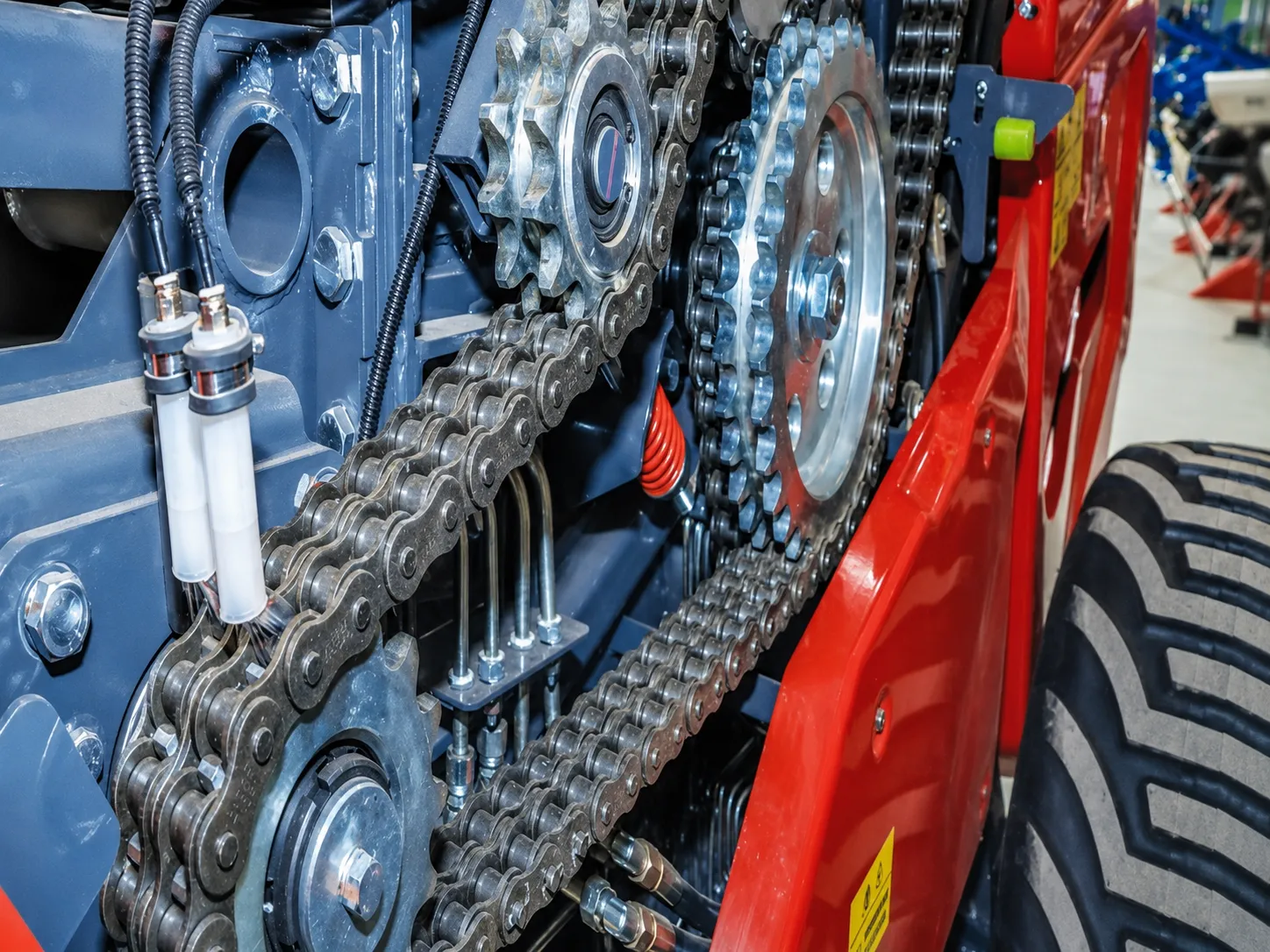
The heavy-duty chain drive transmission on the shredder drive line. Drive chain tension check — 10 to 15mm deflection at mid-span — is a daily pre-operation requirement on the corn stalk baler, more critical than on standard straw balers due to the higher torque loads.
- 9YF-2200S Corn Stalk Baler with Shredder — full specifications and pricing
- Corn Stalk Baling Guide — why standard balers fail and what to use instead
- Tractor Baler Setup Guide — PTO speed and field configuration
- 9YF-2200 Large Square Baler — standard model without shredder
- How to Choose a Baling Machine Manufacturer — verification guide
Frequently Asked Questions
What is the minimum tractor HP for a corn stalk baler with shredder?
The 9YF-2200S single-crusher requires a minimum of 100 HP at the PTO. The dual-crusher requires 110 HP minimum. These requirements are substantially higher than standard square balers because the hammer-claw shredder mechanism adds significant power demand, particularly on dense, high-moisture corn stalk fields early in the baling season.
Can I use a standard square baler with a spring-tooth pickup for corn stalk baling?
Not reliably. Standard spring-tooth pickups are designed for flat, windrowed material and will jam on standing corn stalks within minutes of operation on a typical Corn Belt corn stalk field. Running a standard baler on corn stalks also causes accelerated pickup tine wear, inconsistent bale density, and higher knotter failure rates. The 9YF-2200S with shredder is the correct machine for this application.
What is the moisture content of corn stalks at optimal baling time?
The 9YF-2200S single-crusher handles corn stalks at 10 to 23 percent moisture. The dual-crusher handles up to 28 percent moisture. Optimal baling typically occurs 2 to 4 weeks after corn grain harvest when stalk moisture has dropped to 15 to 20 percent — below the heating threshold for storage but above the brittleness threshold that causes excessive fine material loss.
What is the price difference between the single-crusher and dual-crusher configuration?
The dual-crusher configuration costs approximately $1,500 to $2,000 more FOB than the single-crusher. In landed US cost terms (adding approximately 18 to 22 percent for freight), the difference is roughly $1,800 to $2,500. For biomass and bedding applications the single-crusher is adequate. For dairy feed, silage, or pellet-grade markets where bale cleanliness specifications are strict, the dual-crusher is required and the premium is commercially justified.
How many tons of corn stover can the 9YF-2200S process per hour?
At a forward speed of 3 to 5 mph on average Corn Belt corn stalk density, the 9YF-2200S typically produces 15 to 25 bales per hour. At a bale weight of approximately 700 to 900 lbs per bale for corn stover, this represents approximately 5 to 12 tons per hour depending on conditions. Output varies significantly with field conditions, stalk density, and moisture content.
Tell us your tractor HP, primary crop, and approximate seasonal bale volume. We send a matched model recommendation and factory-direct price — no sales pressure, no intermediary margin.