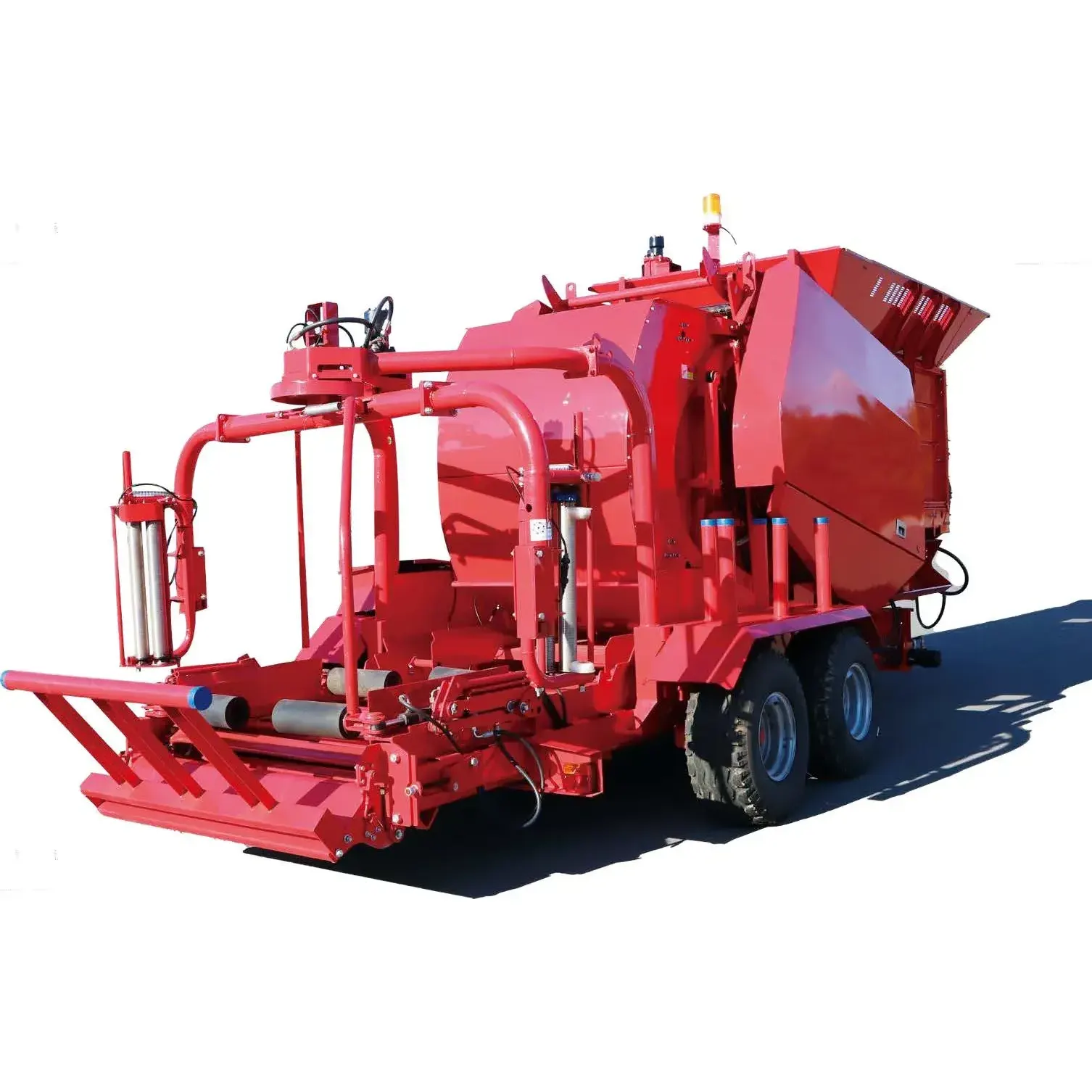
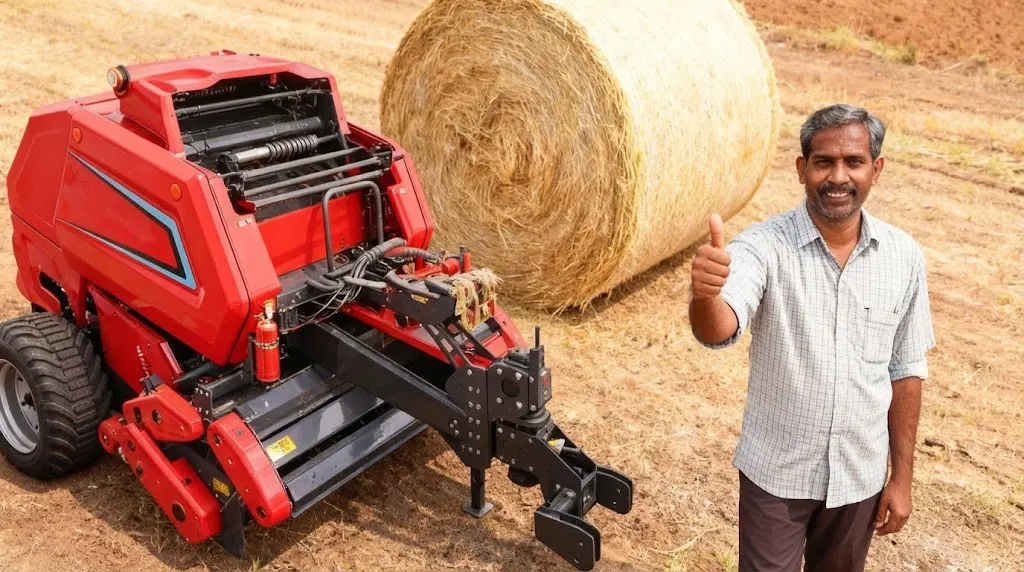
The 9YCM-850 integrated baler-wrapper combination. One tractor, one pass, sealed silage bales — the most efficient silage baler machine setup for mid-to-large dairy operations.
Silage baling is fundamentally different from hay or straw baling in one critical respect: speed. The window between cutting a forage crop and sealing it from oxygen exposure determines the quality of the silage you produce. Every hour of delay between baling and wrapping allows aerobic fermentation to continue — consuming sugars, generating heat, and reducing the nutritional value of the feed. Choosing the right silage baler machine for your dairy farm is not just a cost decision. It is a feed quality decision, and feed quality directly determines milk yield.
This guide covers every silage baling option available from the Ever-Power product range — from compact round balers with separate wrappers to the integrated 9YCM-850 baler-wrapper combination — and walks through the practical economics of each for Indian dairy operations ranging from 50 to over 500 head of cattle.
Why Silage Baling Requires a Different Approach
Standard hay and straw baling aims to preserve dry matter through desiccation — you wait for the crop to dry out, then bale it. Silage works in the opposite direction. You bale the crop at high moisture content (typically 60 to 70 percent for wrapped bale silage) and then seal it from oxygen so that lactic acid bacteria can ferment the sugars into lactic acid. The lactic acid drops the pH below 4.5, which preserves the forage and prevents further decomposition.
The critical implication for equipment selection is this: the time from baling to oxygen exclusion must be as short as possible. For round bale silage using a separate baler and wrapper, the industry recommendation is to wrap within 12 hours of baling. For farmers using a separate wrapper machine on a second tractor, this is manageable. For smaller operations with only one tractor or limited labour, an integrated baler-wrapper that wraps the bale the moment it is ejected is the only practical solution.
Research across dairy operations in India and Southeast Asia consistently shows that silage bales wrapped within 4 hours of production have significantly higher dry matter digestibility and lower pH at opening than bales wrapped 12 to 24 hours after baling. If your current setup involves wrapping the following day, you are losing measurable feed value every season.
Round Baler for Silage — How It Works and What It Costs
The 9YG-2.24D round baler is the most commonly used silage baler machine for mid-to-large dairy farms in India. It produces large round bales in the range of 100 to 200 kg per cubic metre density, with bale dimensions of approximately 1300mm diameter by 1400mm width. The machine uses a high-speed net wrap system to bind the bale, and the operator then moves the bale to a separate wrapper tractor for stretch film application.
9YG-2.24D specifications for silage use
| Specification | Detail |
|---|---|
| Model | 9YG-2.24D round baler (S9000 series) |
| Bale size | 1300mm diameter x 1400mm width |
| Bale density | 100 – 200 kg per cubic metre |
| Output rate | 40 – 100 bales per hour |
| Wrapping method | Net wrap (integrated into baler) |
| Power requirement | 55 – 100 kW (75 – 135 HP) |
| Pickup width | 2240mm spring-tooth |
| Silage suitability | Requires separate wrapper tractor for stretch film |
For silage production, the 9YG-2.24D must be paired with a separate bale wrapper — either a static wrapper or a satellite ring wrapper. The bales should be moved from the field and wrapped within 12 hours of production. For large operations with two tractors and adequate labour, this two-machine system is viable and cost-effective at scale.
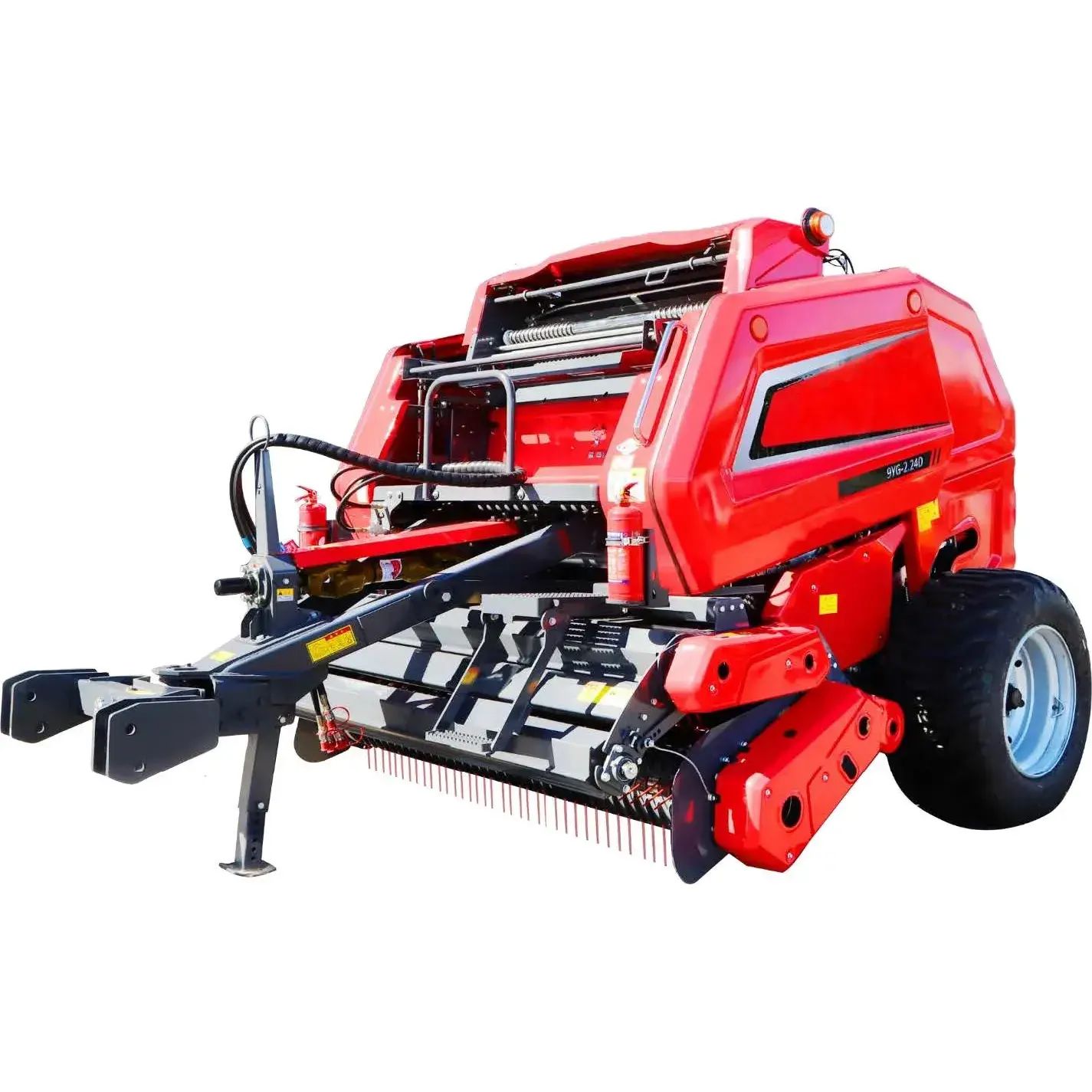
The 9YG-2.24D S9000 series round baler. At 40 to 100 bales per hour output, this is the production workhorse for large silage operations using a two-machine setup.
The 9YG-1.0 compact round baler for smaller dairy operations
For dairy operations of 50 to 150 head where the silage volume requirement is lower, the 9YG-1.0 compact round baler is a practical entry point. It produces smaller bales of 1100mm diameter by 1000mm width — easier for one person to handle and stack. At 48 to 80 kW (65 to 108 HP) power requirement it suits tractors in the 75 to 100 HP range that are common on medium-scale Indian dairy farms.
Square Baler for Silage — When Does It Apply?
Square balers are not the primary choice for traditional silage production with stretch film wrapping, because the compression mechanism is not designed for high-moisture material and the rectangular bale shape makes airtight plastic film application more complex than on round bales. However there are two scenarios where a square baler enters the silage workflow.
Scenario 1: Dry silage or haylage
When forage is cut and field-dried to 40 to 55 percent moisture — sometimes called haylage or dry silage — a square baler can compress it into high-density rectangular bales that are then individually wrapped. The 9YF-1900 and 9YF-2200 are used for this application in some regions of India where dairy operators want the storage efficiency of stackable square bales. This approach requires either individual bale wrapping or storage in a silage clamp after baling.
Scenario 2: Corn stalk silage with dual-crusher
The 9YF-2200S dual-crusher silage baler is specifically designed for corn stalk silage production. It combines a dual-stage hammer-claw shredder with a negative-pressure dust removal fan to produce clean, high-density corn stalk bales with low impurity content. These bales are suitable for wrapping and long-term silage storage for cattle feed. If your dairy operation produces corn-based silage, the dual-crusher model is the correct square baler for the application.
The 9YF-2200S dual-crusher produces bales with significantly lower leaf and dust contamination than standard corn stalk balers. For TMR (Total Mixed Ration) dairy feeding systems where impurity content directly affects palatability and dry matter intake, the cleaner bale produced by the dual-crusher model typically generates a measurable improvement in daily milk yield.
The Integrated Baler-Wrapper Option: 9YCM-850
The 9YCM-850 integrated round baler and wrapper is the most efficient silage baler machine option for dairy farms where labour cost, oxygen exclusion speed, and feed quality are the primary concerns. It combines a fixed-chamber round baler with a high-speed satellite wrapping ring — the bale is wrapped with stretch film the moment it is ejected from the baler, eliminating the window between baling and sealing.
The 9YCM-850 one-pass baler-wrapper. The satellite ring wraps the bale with stretch film immediately upon ejection — oxygen exclusion begins within seconds of baling.
9YCM-850 specifications
| Specification | Detail |
|---|---|
| Bale size | Diameter 85-90cm x Length 85cm |
| Output rate | 30 – 40 bales per hour |
| Power requirement | 120 HP minimum |
| Control system | Fully electronic with sensor density control |
| PTO speed | 540 rpm |
| Wrapping | Integrated satellite ring — wraps on ejection |
| Tractor requirement | One tractor only — no second tractor needed |
Economic case for the integrated system
The 9YCM-850 costs more than a standalone round baler. But the economic case for the integrated system is compelling for any dairy operation running over 150 head of cattle. By eliminating the second tractor and second operator from the wrapping operation, the integrated system cuts direct labour cost by approximately 40 to 50 percent compared to a two-machine setup. Over a 5-year period this typically covers the price premium of the integrated machine two to three times over.
Cost Comparison for Indian Dairy Farms
The following comparison is based on a 200-head dairy operation producing silage from 50 hectares of corn and sorghum forage per year. All costs are indicative and will vary by region, tractor operating costs, and wrapper film pricing.
| Setup | Equipment cost (FOB) | Annual labour saving | Wrapper film per year | Practical for |
|---|---|---|---|---|
| 9YG-2.24D + separate wrapper | $14,000 – $19,000 | Baseline | High | Farms with 2 tractors and labour |
| 9YG-1.0 + separate wrapper | $8,000 – $11,000 | Baseline | Moderate | Small dairy 50-100 head |
| 9YCM-850 integrated | $25,000 – $32,000 | 40-50% labour saving | Included | Farms prioritising feed quality |
All Ever-Power silage baler machine models including the 9YCM-850 carry CE and ISO certification and are eligible for consideration under India’s SMAM subsidy scheme. At 25 to 50 percent subsidy the effective acquisition cost reduces significantly. Contact your local Krishi Vigyan Kendra for eligibility assessment before making a purchase decision.
Moisture Content and Silage Quality — the Technical Guide
Getting the moisture content right before baling is the most important agronomic decision in the silage production process. The baler itself cannot compensate for incorrect crop moisture — if you bale too wet you get clostridial fermentation and butyric acid production; too dry and you get aerobic spoilage at the bale surface.
Target moisture ranges by crop type
| Crop | Target moisture for wrapped bale silage | Notes |
|---|---|---|
| Corn stalks (whole plant) | 60 – 70% | Harvest at 2/3 milk line stage for optimal sugar content |
| Sorghum | 60 – 68% | Cut before seed head fully matures |
| Alfalfa (haylage) | 45 – 55% | Field wilt to target before baling |
| Grass silage | 60 – 70% | Cut at late vegetative / early heading stage |
| Paddy straw (silage use) | 60 – 65% | Rare application — requires inoculant addition |
Measuring moisture in the field is straightforward with a handheld hay probe or by sending a grab sample to a laboratory. Many feed companies and agricultural universities in India offer rapid moisture testing services for farmers producing silage commercially.
Dairy cattle feeding on round bale silage. The nutritional value of the silage depends almost entirely on how quickly the bale was sealed after production.
- 9YCM-850 Round Baler Wrapper Combination — one-pass silage system specifications
- 9YG-2.24D S9000 Large Round Baler — high-output silage baler for large dairy farms
- 9YG-1.0 Compact Round Baler — silage and forage baling for smaller dairy operations
- Straw Baler Machine Price Guide 2026 — full FOB price ranges across all models
- Round Baler vs Square Baler — full comparison guide for Indian farmers
Frequently Asked Questions
What is the best silage baler machine for a 200-head dairy farm in India?
For a 200-head dairy operation the 9YCM-850 integrated baler-wrapper combination is the most efficient option where capital allows. It eliminates the second tractor and wrapping crew, seals bales immediately on ejection, and produces consistent high-density silage bales. If capital is constrained, the 9YG-2.24D round baler paired with a separate wrapper is the next best option — but wrapping must happen within 12 hours of baling.
Can a square baler be used for silage production?
Standard square balers (9YF series) are not recommended for high-moisture silage material — the compression mechanism is not designed for 60 to 70 percent moisture crops. However the 9YF-2200S dual-crusher silage baler is specifically engineered for corn stalk silage production, producing clean high-density bales suitable for wrapping and storage. For haylage at 45 to 55 percent moisture, standard square balers can be used with individual bale wrapping.
How many layers of stretch film does a silage round bale need?
The standard recommendation for wrapped round bale silage is 4 to 6 layers of 25-micron stretch film, or 2 to 3 layers of 50-micron film. More layers reduce oxygen ingress and extend storage life. The 9YCM-850 integrated system applies a consistent number of film layers automatically via the electronic control system — eliminating the inconsistency that occurs when separate wrapper operators manually control application.
What is the minimum tractor HP required for the 9YCM-850 silage baler?
The 9YCM-850 requires a minimum of 120 HP (approximately 88 kW). It uses 540 rpm PTO drive with heavy-duty gearboxes. The hydraulic system requires two remote valve sets (one for baler functions and one for the satellite wrapper ring). Confirm your tractor has both remote hydraulic outputs available before ordering.
Is silage production equipment eligible for government subsidy in India?
Silage-related baling equipment including round balers and integrated baler-wrapper combinations are eligible for consideration under the SMAM scheme where CE certification is held. Ever-Power silage baler machine products carry CE and ISO certification. Eligibility and subsidy percentage vary by state and applicant category. Contact your local Krishi Vigyan Kendra or District Agriculture Office for current scheme details.
Tell us your tractor HP, primary crop, and approximate seasonal bale volume. We send a matched model recommendation and factory-direct price — no sales pressure, no intermediary margin.